
Dune: Part Three: 10 Things to Know Before the 18 December UK Release
Upcoming Movies 7th October 2026 Radek Sinclair
By the Filmoria News Desk

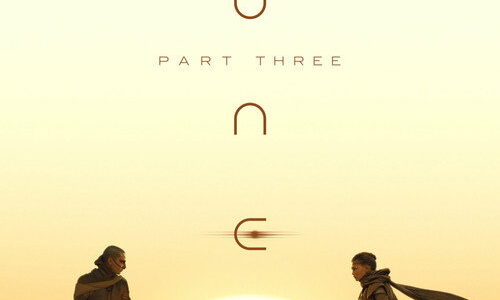
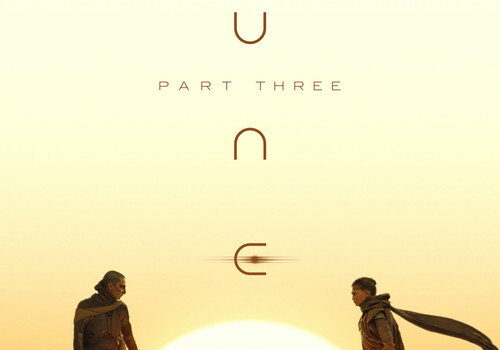
Official poster © Warner Bros. Pictures / Legendary Entertainment.
Dune: Part Three, Denis Villeneuve’s adaptation of Frank Herbert’s Dune Messiah, opens in UK cinemas on 18 December 2026, with IMAX preview screenings from 15 December. It runs 140 minutes, 71 of them in IMAX’s expanded aspect ratio, and it won’t be on a streaming service in the UK until after its cinema run. Timothée Chalamet and Zendaya return, with Robert Pattinson joining as the shape-shifting assassin Scytale.
Quick Facts
- Film: Dune: Part Three (2026), adapted from Frank Herbert’s 1969 novel Dune Messiah
- Director: Denis Villeneuve
- Cast: Timothée Chalamet, Zendaya, Florence Pugh, Rebecca Ferguson, Javier Bardem, Jason Momoa, Anya Taylor-Joy, Robert Pattinson, Isaach De Bankolé
- Studio: Legendary Entertainment; distributed by Warner Bros. Pictures
- Release date: 18 December 2026 in the UK and North America; international roll-out from 16 December
- Runtime: 140 minutes (2 hours 20 minutes), per IMAX
- Score: Hans Zimmer
In the UK
- Cinema release: 18 December 2026 nationwide, with IMAX preview screenings on 15 December.
- IMAX 70mm screens: BFI IMAX (London), The Ronson Theatre at the Science Museum (London) and Vue Manchester Printworks.
- Streaming: Cinemas only at launch. A UK streaming home is not yet confirmed for the UK.
- BBFC rating: Not yet confirmed for the UK. Both earlier films were rated 12A.
- Ticket prices: Vary by venue. Glasgow Science Centre’s IMAX preview on 15 December lists £12.15 for adults, £10.75 concessions and £9.35 for children.
The first thing to know about Dune: Part Three in Britain is that, if you wanted the best seat in the country, you’ve probably already missed it. BFI IMAX on London’s South Bank put its opening-weekend 70mm shows on sale (Friday 18 December at 18:45, Saturday at 21:00, Sunday at 20:30) and, according to Film Stories, all three sold out almost immediately. Time Out reported tickets vanishing within minutes. That’s two and a half months out from release, for a sequel to an adaptation of a novel many readers consider the weakest book in the series.
This is a list of the 10 things to know about Dune: Part Three before it reaches UK cinemas on 18 December 2026. We ordered it the way most people actually ask about a film like this: when and how to see it first, then the story and cast, then the crew, the production and the marketing, and finally what’s riding on it. Every figure comes from studio, IMAX or cinema announcements and trade reporting, and where something hasn’t been disclosed we say so.
| # | Topic | Key Fact | Status | Source |
|---|---|---|---|---|
| 1 | UK release date | 18 December 2026; IMAX previews 15 December | Confirmed | Warner Bros. / UK cinemas |
| 2 | IMAX 70mm in the UK | BFI IMAX, Science Museum, Vue Manchester Printworks | BFI opening weekend sold out | Time Out / Film Stories |
| 3 | Runtime and format | 140 minutes, 71 in IMAX expanded ratio | Confirmed | IMAX |
| 4 | Story | Adapts Dune Messiah; Paul as Emperor | Confirmed | Legendary / Warner Bros. |
| 5 | Returning cast | Chalamet, Zendaya, Pugh, Ferguson, Bardem, Taylor-Joy | Confirmed | Character posters, March 2026 |
| 6 | New cast | Pattinson as Scytale; Momoa back as Hayt | Confirmed | Character posters / trailer |
| 7 | Crew | Linus Sandgren replaces Greig Fraser as cinematographer | Confirmed | Legendary / Warner Bros. |
| 8 | Production | July to November 2025, Budapest and Abu Dhabi | Wrapped | Screen Global Production / Abu Dhabi Film Commission |
| 9 | Marketing | Posters March, trailer 8 July, IMAX tickets on sale | Ongoing | Legendary / IMAX |
| 10 | Box office stakes | Opens same day as Avengers: Doomsday; budget | Budget not disclosed | Trade reporting |
1. UK Release Date (18 December 2026, Warner Bros. Pictures)
What makes it stand out: It arrives in the busiest week of the cinema year, on the same Friday as Marvel’s Avengers: Doomsday.
Key data: Nationwide UK release on 18 December 2026, IMAX preview screenings on Tuesday 15 December, and an international roll-out beginning 16 December, according to Legendary and Warner Bros.
Why it matters: UK audiences get it on the same date as North America, and IMAX fans get it three days early.
Warner Bros. has stuck with the December date for well over a year now, which isn’t something you can say about every blockbuster on the 2026 calendar. The official line from Legendary and Warner Bros. is that the film opens “only in theaters and IMAX” in North America on 18 December and internationally from 16 December. Britain falls on the later of the two, with nationwide shows from Friday 18 December.
The wrinkle is the preview night. UK cinemas, including IMAX sites, are running screenings on Tuesday 15 December. Glasgow Science Centre’s IMAX has already added a second, late 22:45 show to its preview list, which tells you something about demand outside London too.
In the US, IMAX is running what it calls “Dune Insider” screenings: IMAX 70mm sites from Monday 14 December, every IMAX screen from 15 December and other premium formats such as Dolby from 17 December. The UK hasn’t had an identical tiered plan announced. If you’re booking, the 15 December IMAX preview is the earliest confirmed way to see it here.
One more practical point. Christmas week ticket prices tend to sit at the top end of a cinema’s range, and premium screens more so. If price matters, check weekday matinees in the first week of January, when the queues should calm down. Our Upcoming Movies roundup has the rest of the winter calendar if you’re planning several trips.
2. IMAX 70mm in the UK (Three Screens, One Already Sold Out)
What makes it stand out: Only three UK cinemas can project it on IMAX 70mm film, and the biggest of them sold its opening weekend in minutes.
Key data: BFI IMAX in London, The Ronson Theatre at the Science Museum in London and Vue Manchester Printworks are the UK’s IMAX 70mm venues, according to Time Out; BFI IMAX’s first 70mm shows are 18, 19 and 20 December.
Why it matters: 70mm IMAX is how Villeneuve and IMAX are selling the film, and the UK has very little of it.
BFI IMAX is the UK’s largest cinema screen, and it has become a kind of pilgrimage site for large-format releases. The South Bank venue listed three initial 70mm shows: 18:45 on Friday 18 December, 21:00 on Saturday 19 December and 20:30 on Sunday 20 December, with a note that more dates would follow. Film Stories reported that all three sold out. Time Out said the tickets went within minutes.
Worldwide, the number of screens that can run 70mm IMAX film prints is tiny. Canadian broadcaster CTV put it at 41 cinemas around the globe in a report on Regina’s IMAX, while Hypebeast counted 25 in the United States. Those numbers aren’t directly comparable, and neither source explains its count, but either way the UK’s share is three.
So what should you do if you missed out? Watch for extra dates. BFI IMAX has said more will be added, and both the Science Museum and Vue Printworks have smaller allocations that tend to be released in waves. Standard IMAX with Laser screens across the country will still show the expanded-ratio scenes, just not on film. Honestly, for most viewers that’s the better trade-off: easier to book, cheaper, and a picture that’s very close to the film print.
3. Runtime and IMAX Format (140 Minutes, 71 in IMAX Ratio)

Amy Adams in Arrival (2016), one of Villeneuve’s earlier science fiction films. Photo: Lava Bear Films.
What makes it stand out: It’s the shortest of Villeneuve’s three Dune films, and the first in the series to use IMAX film cameras.
Key data: 140 minutes in total, with 71 minutes presented in IMAX’s 1.90:1 expanded aspect ratio, opening up to 1.43:1 in select IMAX with Laser and 70mm venues, according to IMAX.
Why it matters: Half the film fills the whole IMAX screen, which is a big part of why those 70mm seats went so fast.
A 2 hour 20 minute runtime surprised people. Dune: Part Two ran 166 minutes, and the 2021 film ran 155. After two films that both pushed past two and a half hours, plenty of fans assumed the finale would be the longest yet. It isn’t. That fits the source, though. Dune Messiah is a short novel, far slimmer than Dune itself, and much of it is conspiracy and conversation rather than battle.
The format detail is more interesting. IMAX says this is the first film in the franchise shot on a mix of IMAX-certified digital cameras and IMAX film cameras. The earlier films used digital cameras only. IMAX claims its film cameras offer close to ten times the resolution of conventional 35mm film and three times that of standard 5-perf 65mm.
Unlike Christopher Nolan’s The Odyssey, which was shot entirely on IMAX film, Part Three isn’t IMAX from start to finish. About half the runtime, 71 minutes, uses the expanded ratio. The rest is in a wider, letterboxed frame. In a regular cinema you won’t notice the switch. In IMAX, the image will grow to fill the screen in the big moments, the way Part Two did in its desert sequences.
4. The Story: Paul as Emperor (Adapted From Dune Messiah, 1969)
What makes it stand out: The hero of the first two films is now the ruler of the known universe, and the film treats that as a tragedy.
Key data: Based on Frank Herbert’s 1969 novel Dune Messiah and reportedly set about 17 years after the events of Dune: Part Two.
Why it matters: It’s the chapter that tells you Paul Atreides was never a straightforward hero, which Villeneuve has been hinting at since 2021.
At the end of Part Two, Paul defeats the Harkonnens, forces the Emperor to abdicate and claims his daughter, Princess Irulan, in marriage. Chani walks away. The Fremen launch a holy war across the galaxy in his name. Dune Messiah picks up years later, with that war won and Paul sitting on the throne he took.
Herbert wrote the book partly as a response to readers who saw Paul as a saviour. In Messiah, the jihad has killed billions, Paul’s visions have trapped him rather than freed him, and a conspiracy forms against him that brings together the Bene Gesserit, the Spacing Guild, the Tleilaxu and the bitter Irulan. Chani, still his partner but not his wife, is at the centre of a plot about who will bear his heir.
The trailers lean into this. The July footage shows Paul preparing for war again and facing off against Robert Pattinson’s Scytale, and reviews of the footage describe a version of Paul asking for forgiveness rather than demanding loyalty. Villeneuve has said this one is more action-driven and tense than the first two, which is a little surprising given how talky the novel is. Expect him to have expanded the book’s few set pieces and brought forward its sense of dread.
If you haven’t read Messiah, there’s an ending coming that some readers find shocking. We won’t say more. Just stay off the forums in December.
5. Returning Cast: Chalamet, Zendaya, Pugh, Ferguson, Bardem and Taylor-Joy

Timothée Chalamet, Paul Atreides in Dune: Part Three, pictured in Beautiful Boy (2018). Photo: Francois Duhamel, courtesy of Amazon Studios.
What makes it stand out: Nearly every major surviving character from Part Two comes back, several of them in very different positions.
Key data: Timothée Chalamet (Paul), Zendaya (Chani), Florence Pugh (Princess Irulan), Rebecca Ferguson (Lady Jessica), Javier Bardem (Stilgar) and Anya Taylor-Joy (Alia Atreides) all return, according to the March 2026 character posters and later marketing.
Why it matters: Continuity of cast was never guaranteed for a film made two years after Part Two, and keeping everyone together gives the trilogy a proper ending.
Chalamet is the obvious anchor. The first official image, which he shared on Instagram, showed Paul in desert robes with heavy scarring on his face. It’s a deliberate break from the beautiful young prince of the first film. He’s older, harder and visibly marked by the war he started.
Zendaya’s Chani is the emotional centre of the book, and Part Two already changed her arc by making her openly sceptical of Paul’s messianic turn. One of the March character posters showed her fierce and set-jawed, which is probably the right signal. Florence Pugh’s Irulan moves from the edges of Part Two to a much bigger role. In the novel she’s Paul’s wife in name only and one of the conspirators against him, so Pugh finally has real material.
Anya Taylor-Joy’s casting as Alia was the big secret of Part Two, where she appeared only briefly as an adult in one of Paul’s visions. Here Alia is a teenager with unsettling, inherited memories, and at least one outlet has reported that the role is significantly larger. Rebecca Ferguson’s Jessica and Javier Bardem’s Stilgar are both back, Stilgar now a loyal but uneasy servant of the empire he helped build.
A few listings also name Josh Brolin and Léa Seydoux. We haven’t seen Warner Bros. or Legendary confirm either for this film, so treat those as unconfirmed until the studio says otherwise.
6. New Faces: Robert Pattinson as Scytale and Jason Momoa as Hayt

Robert Pattinson at the Good Time photocall in Cannes. Photo: Festival de Cannes.
What makes it stand out: The franchise’s new villain is a shape-shifter, played by one of the most unpredictable actors of his generation.
Key data: Robert Pattinson plays Scytale, a Tleilaxu Face Dancer; Jason Momoa returns as Hayt, a resurrected version of Duncan Idaho; Isaach De Bankolé plays the Fremen Farok; Ida Brooke and Nakoa-Wolf Momoa play Paul’s children Ghanima and Leto II.
Why it matters: Scytale drives the plot, and Hayt is the returning character fans have wanted to see since Duncan died in 2021.
Pattinson’s casting was announced alongside the character posters in March 2026, and the trailers show him with a bleached blond buzz cut that makes him look more like a Bond henchman than a gothic hero. Scytale belongs to the Tleilaxu, a secretive group of genetic engineers whose Face Dancers can take on anyone’s appearance. Asked about the role, Pattinson said: “You can’t really tell whose side he’s on.” That’s about as much as he’s given away.
He also told interviewers the shoot was gruelling: “It was so hot in the desert.” The Abu Dhabi portion of filming ran through late summer and autumn, so you can believe him.
Jason Momoa’s return needs a little explanation for people who haven’t read the books. Duncan Idaho died defending Paul in the first film. In Messiah, the Tleilaxu bring him back as a ghola, a grown clone with no memories of his former life, and give him to Paul as a gift. The name he goes by is Hayt. Some coverage simply lists Momoa as Duncan Idaho, but the character posters and most reporting use Hayt, and that’s the book-accurate version.
There’s a nice bit of casting trivia in there too. Paul’s son, Leto II, is played by Nakoa-Wolf Momoa, Jason Momoa’s real son. Given where Leto’s story goes in later books, that’s a quietly significant role.
7. Villeneuve and the Crew (Linus Sandgren Replaces Greig Fraser)
What makes it stand out: For the first time, Villeneuve’s Dune has a different cinematographer.
Key data: Directed by Denis Villeneuve; shot by Linus Sandgren; production design by Patrice Vermette; edited by Joe Walker; costumes by Jacqueline West; casting by Francine Maisler; music by Hans Zimmer.
Why it matters: The look of Dune is half of its appeal, and changing the person behind the camera is the biggest creative risk in the whole project.
Greig Fraser shot both earlier films and won an Oscar for the first. He couldn’t return because of scheduling commitments, so the job went to Linus Sandgren, who won his own Oscar for La La Land and shot No Time to Die and Babylon. Sandgren has a warmer, more classical style than Fraser, who leaned into a hazy, desaturated palette. It’ll be interesting to see whether Arrakis looks different. On the evidence of the trailers, Villeneuve has kept the overall visual language consistent, which suggests Sandgren was told to match rather than reinvent.
Everyone else is back. Patrice Vermette won an Oscar for the first film’s production design. Joe Walker won for editing it. Hans Zimmer won Best Original Score for Dune in 2022 and returns to write his third score for the series. Jacqueline West, Oscar-nominated for the first film’s costumes, is back too.
For Villeneuve, this is the end of a long road. He’s said he wants Part Three to be his final Dune film, closing what he calls Paul’s story. At one point he described the first two films as “really a diptych,” and suggested a third wouldn’t be “like a trilogy.” The marketing now calls it the final chapter. Whatever you call it, his filmography from Arrival to Blade Runner 2049 to these films makes him the most consistent maker of big, serious science fiction working today.
8. Production: Budapest and Abu Dhabi (July to November 2025)
What makes it stand out: It was the franchise’s biggest shoot yet in the Abu Dhabi desert that stands in for Arrakis.
Key data: Principal photography ran from July to November 2025 at Origo Studios in Budapest and on location in Abu Dhabi, including 31 days in the Liwa desert and Al Ain with more than 600 UAE-based crew, supported by a 35% production rebate.
Why it matters: A tight, efficient shoot is what made a December 2026 release possible.
Cameras rolled in Hungary in July 2025, at Origo Studios, where both previous films were made, with Budapest-based Pioneer Stillking providing local production services. Interior sets, the palaces of the new imperial capital and the effects-heavy scenes were shot there.
The production moved to the Liwa desert in Abu Dhabi later in 2025. Abu Dhabi’s Film Commission says the shoot ran for 31 days, two of them in Al Ain, and employed more than 600 people based in the UAE, making it the largest local shoot in the franchise. Image Nation Abu Dhabi was a production partner. The region has hosted all three films, and Liwa’s dunes are as much a part of the trilogy’s look as any set.
Filming wrapped in November 2025. That gave Villeneuve about a year for post-production, effects and the IMAX finishing. It sounds like a lot, but for a film of this scale it’s tight. Part Two, for comparison, finished filming in December 2022 and was released in March 2024, after a strike-related delay from its original November 2023 date.
9. Marketing Timeline: Posters, the July Trailer and IMAX Tickets
What makes it stand out: Warner Bros. sold IMAX tickets months before it had shown a full trailer.
Key data: Nine character posters and the first look at Paul arrived in March 2026; the official trailer premiered at a global IMAX event on 8 July 2026; IMAX announced its Insider screenings on 18 August 2026.
Why it matters: Selling tickets this early is a signal of confidence, and the early sell-outs have proved the studio right.
Here’s how the campaign has rolled out so far:
- March 2026: nine character posters released on social media, including the first images of Pattinson’s Scytale and De Bankolé’s Farok, plus a teaser and Chalamet’s first-look image of a scarred Paul.
- April 2026: a 38-second promo announcing that IMAX 70mm tickets were on sale in the US, with heavy early demand reported.
- May 2026: The Art and Soul of Dune: Part Three, the official making-of book, was announced.
- 8 July 2026: the official trailer debuted at a global IMAX fan event, with behind-the-scenes photos of Villeneuve directing Chalamet and Zendaya in the Liwa desert, taken by Niko Tavernise.
- August 2026: IMAX announced the Dune Insider screenings, and ticket sites in the US struggled under the demand.
- Later rounds: a further release of premium-format and fan-screening tickets, accompanied by another new trailer.
The UK campaign has followed a few weeks behind. BFI IMAX’s 70mm dates went on sale in late summer, and preview listings for 15 December are now live at IMAX venues around the country. Regular showtimes at chains like Odeon, Cineworld and Vue usually go on sale four to six weeks before release, so expect general booking to open in November.
The full trailer is on Warner Bros. UK’s and Legendary’s official YouTube channels. If you only watch one piece of marketing, watch that one.
10. The Box Office Stakes (Same Day as Avengers: Doomsday)
What makes it stand out: Two of the year’s biggest films open on the same day, which almost never happens.
Key data: Dune: Part Two grossed more than $700 million worldwide in 2024; the first film made just over $400 million during the pandemic; Part Three’s budget has not been disclosed.
Why it matters: The head-to-head with Doomsday will decide how many premium screens Dune keeps over Christmas.
Avengers: Doomsday also opens on 18 December. Two films of this scale don’t normally share a date, because both studios want IMAX and the other premium screens. This time, IMAX has clearly taken a side. Its press materials, its early-access screenings and its 70mm allocation are all built around Dune. Doomsday will still be everywhere, but in IMAX auditoriums, Villeneuve’s film has the stronger hand at least for the opening stretch.
The franchise numbers are strong. The 2021 film opened day-and-date on HBO Max in the US and still made just over $400 million worldwide. Dune: Part Two had a full cinema window and finished above $700 million, one of the biggest results of 2024. Between them, the two films won eight Oscars: six for the first and two for Part Two.
Warner Bros. and Legendary haven’t disclosed Part Three’s budget, and we won’t guess. What we can say is that a shorter runtime helps the business case, since cinemas can fit more shows into a day, and the early ticket demand suggests a big opening. The bigger question is the long run. Christmas and New Year are the best weeks of the year for cinema, and Dune and Doomsday will both be trying to stay on the big screens into January.
The Bottom Line on Dune: Part Three
On paper, this is the most interesting of Villeneuve’s three Dune films. It’s shorter, darker and more ambitious in format than Part Two, it adds Pattinson to an already excellent cast, and it tells the part of Herbert’s story where the hero turns out to be the problem. The changes behind the camera, Sandgren replacing Fraser above all, are the one real unknown.
For UK audiences the practical advice is simple. If you want IMAX 70mm, watch BFI IMAX, the Science Museum and Vue Printworks for extra dates. If you just want IMAX, book the 15 December preview or opening weekend once your local site releases seats. Everyone else can walk in on 18 December. We’ll have a full review closer to release.
Last updated: 7 October 2026.
Sources: IMAX, Legendary Entertainment and Warner Bros. Pictures press release, Screen Global Production, Time Out, South Bank London (BFI IMAX), Film Stories.
Frequently Asked Questions
Does Dune: Part Three come out on the same day as Avengers: Doomsday?
Yes. Both films open in UK and North American cinemas on Friday 18 December 2026.
Who plays Alia Atreides in Dune: Part Three?
Anya Taylor-Joy plays Alia Atreides, Paul’s sister, after a brief appearance in a vision in Dune: Part Two.
When did the Dune: Part Three trailer come out?
The official trailer premiered at a global IMAX event on 8 July 2026, after a teaser and nine character posters in March 2026.
Who does Robert Pattinson play in Dune: Part Three?
Robert Pattinson plays Scytale, a shape-shifting Tleilaxu Face Dancer who joins a conspiracy against Paul Atreides.
Is Jason Momoa in Dune: Part Three?
Yes. Jason Momoa returns as Hayt, a ghola, or resurrected clone, of Duncan Idaho, the character he played in the 2021 film.
Where can I see Dune: Part Three in IMAX 70mm in the UK?
Three UK cinemas can show it in IMAX 70mm: BFI IMAX and The Ronson Theatre at the Science Museum in London, and Vue Manchester Printworks.
How much of Dune: Part Three was filmed in IMAX?
IMAX says 71 minutes of the 140-minute film are presented in its expanded 1.90:1 aspect ratio, opening up to 1.43:1 in select IMAX with Laser and 70mm cinemas.
Where was Dune: Part Three filmed?
It was filmed from July to November 2025 at Origo Studios in Budapest, Hungary, and in the Liwa desert and Al Ain in Abu Dhabi.
Who is the cinematographer on Dune: Part Three?
Linus Sandgren, the Oscar-winning cinematographer of La La Land, shot Dune: Part Three after Greig Fraser was unavailable because of scheduling commitments.
Will Dune: Part Three be on streaming in the UK?
Not at launch. Dune: Part Three is a cinema-only release from 18 December 2026, and its UK streaming home has not yet been confirmed.
📸 Follow us on Instagram for daily film, TV & gaming news: @filmoriauk

Radek Sinclair
Writes on European and world cinema for Filmoria, with a particular interest in festival titles making their way onto UK screens and streaming services.