


The Odyssey Crosses $1 Billion Internationally — First Original Film to Do It Since Avatar
Box Office 16th September 2026 Scott Allden
By the Filmoria News Desk
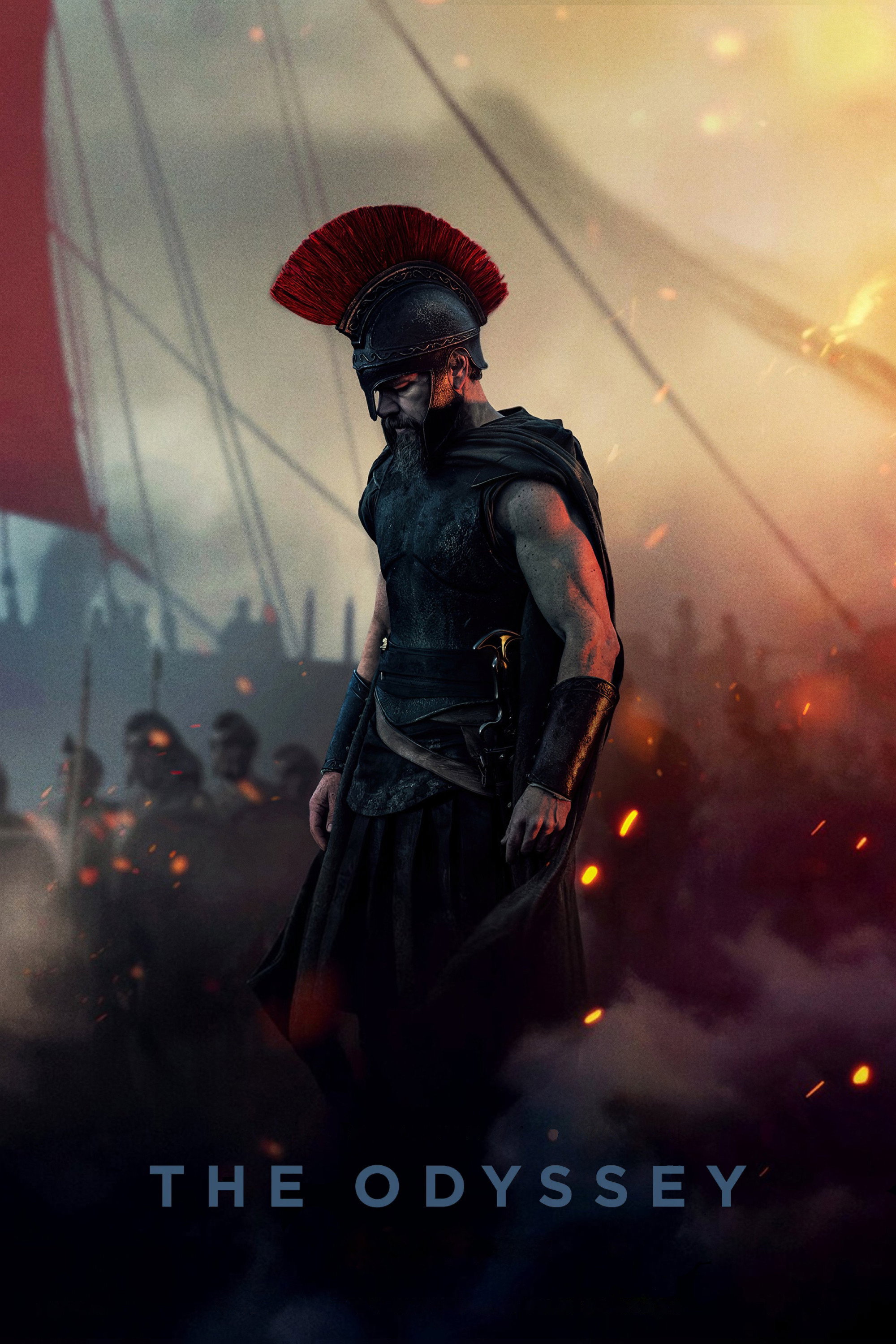
Official poster © Universal Pictures, via TMDB.
Two months ago, the safe bet on Christopher Nolan’s The Odyssey was that it would open huge, hold reasonably well, and settle into the same lane as Oppenheimer: a critical and awards darling that made real money without threatening the all-time charts. That bet is now looking badly undercooked. As of this week, The Odyssey has crossed $1 billion at the international box office alone, a threshold only sixteen other films in cinema history had reached before it — and the last original story, not a sequel, not a remake, not built on an existing franchise, to get there overseas was James Cameron’s Avatar, back in 2009. Seventeen years is a long gap for the industry’s supposed bread and butter. It says less about this specific film’s quality, arguably, than it does about how thoroughly Hollywood had convinced itself original event movies didn’t travel anymore.
Quick Facts
- Film: The Odyssey
- Director/Writer: Christopher Nolan
- Studio: Universal Pictures / Syncopy
- Cast: Matt Damon, Tom Holland, Anne Hathaway, Robert Pattinson, Zendaya, Charlize Theron, Lupita Nyong’o, Samantha Morton, and a large ensemble
- Released: July 17, 2026 (US/UK); premiered July 6 in London
- Runtime: 173 minutes
- Budget: Approximately $250 million
- Box office (as of this week): $595M domestic, $1.062B international, $1.657B worldwide
- Milestone: 17th film ever to cross $1 billion at the international box office; first original (non-sequel, non-remake) film to do so since Avatar in 2009
- Rating: R (MPA) / 15 (BBFC), primarily for strong violence
The Milestone, By the Numbers
Let’s start with what actually happened, because the raw figures are worth sitting with for a second. The Odyssey opened with $264 million internationally across its first three days, already the biggest overseas launch of Nolan’s career by some distance. It’s kept that pace up for two months rather than the usual four-to-six-week burn-and-fade that even successful blockbusters go through, and this week it tipped over $1 billion in foreign ticket sales, pushing its worldwide total to roughly $1.657 billion. Domestically it’s sitting around $595 million. Add it up and this is now, comfortably, Christopher Nolan’s highest-grossing film ever, ahead of The Dark Knight Rises, ahead of Oppenheimer, ahead of anything else he’s made in a quarter-century of directing.
Universal’s own framing of the moment, from Veronika Kwan Vandenberg, the studio’s president of international distribution, was characteristically understated for a number this large: “From its record-breaking opening to this historic milestone, The Odyssey has captivated audiences around the world.” Understated or not, the studio has earned the right to a victory lap. A $250 million bet on a three-hour R-rated adaptation of a 2,800-year-old poem, shot largely on unwieldy IMAX film cameras, is not the kind of project that gets greenlit on vibes. Someone at Universal did the math and decided Nolan’s name, plus an ensemble cast stacked with A-listers, plus an unprecedented theatrical presentation, added up to a movie people would leave the house for. They were right, and by a wider margin than anyone was projecting back in July.
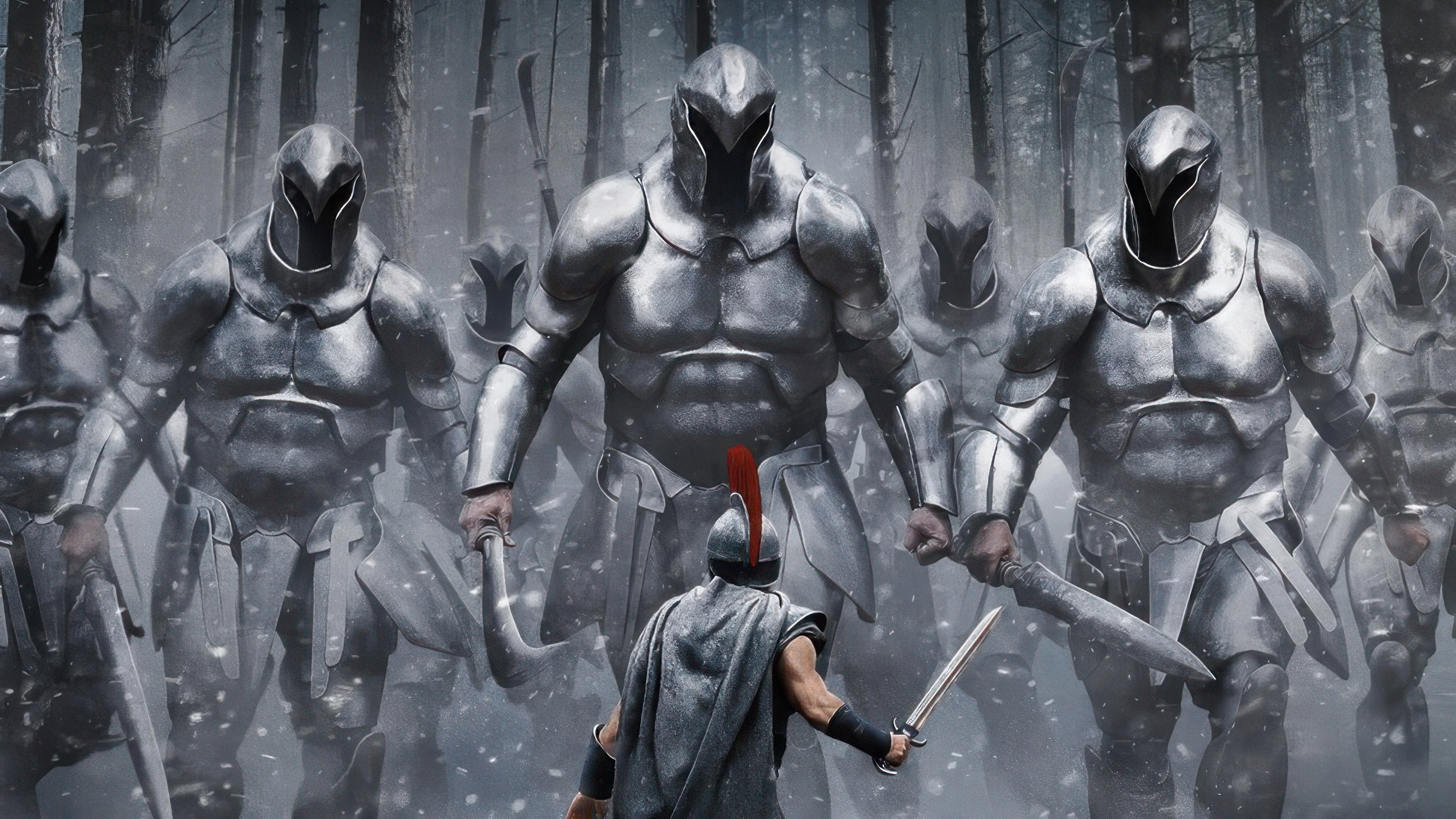
Production still © Universal Pictures, via TMDB.
Why an Original Film Crossing $1 Billion Overseas Is So Rare
It’s worth being precise about what record actually just fell, because “biggest movie of the year” and “first original film to hit $1 billion internationally since Avatar” are two very different claims, and the second one is the genuinely startling one. Plenty of films have crossed a billion dollars worldwide since 2009 — the Avengers pictures, several Star Wars entries, assorted Disney live-action remakes, the odd Fast & Furious sequel. Almost none of them did it primarily on the strength of international box office for a story audiences hadn’t already paid to see in some other form. Sequels have built-in curiosity. Remakes and reboots borrow recognition from whatever they’re rebooting. An adaptation of a public-domain Greek epic that most people last encountered in a ninth-grade English class doesn’t have that scaffolding, even with a title everyone technically already knows.
That’s the gap this crossing actually measures: not “can a Hollywood movie make money overseas” but “can something original still do it at the very top of the scale, without a built-in fanbase carrying the opening weekend.” For seventeen years, on this specific metric, the answer had quietly been no. Mid-budget originals could still work internationally. Auteur-driven prestige pictures could win Oscars and turn tidy profits. But the billion-dollar-overseas tier had become, almost without anyone declaring it a rule, a sequels-and-superheroes-only club. The Odyssey getting in on the strength of Nolan’s name, an IMAX gimmick that turned out not to be a gimmick, and word of mouth that apparently held up for two straight months is the kind of thing studio executives will be citing in pitch meetings for years, for better or worse.
How Nolan Turned a 2,800-Year-Old Poem Into a Billion-Dollar Global Event
None of this happened by accident, and the marketing and exhibition strategy behind The Odyssey deserves almost as much credit as the film itself. Nolan shot the entire movie on IMAX 70mm cameras — not just select sequences, the way Oppenheimer and Tenet used the format, but the whole production, reportedly burning through more than two million feet of film stock at a cost of roughly $3 million just in raw material. FotoKem in Burbank, the last full-service 70mm lab left standing, processed all of it. A new, lighter and quieter IMAX camera rig had to be built specifically for the shoot, because the existing hardware wasn’t practical for the kind of handheld and mobile coverage Nolan wanted across six countries of location work.
The exhibition side leaned into scarcity rather than fighting it. Only 41 screens worldwide can actually show the film in true IMAX 70mm — 25 in the US, nine in Canada, three in the UK, single screens scattered across Australia, Belgium, France and the Czech Republic. Universal sold opening-weekend tickets for those 41 screens a full year in advance, and roughly half of the 22 available US locations sold out within twelve hours of going on sale, pulling in around $1.5 million before a single review had been published. By late July, with 70mm shows still selling out weeks ahead, Universal extended the format’s theatrical run well past the point most films have moved on to streaming conversations. IMAX box office alone for this film has now cleared $457 million, the biggest IMAX run any movie has ever had.
The marketing rollout matched that scale without tipping into overexposure. A six-minute Trojan Horse prologue screened before select December releases, a 70-second teaser played ahead of Jurassic World Rebirth, and a December trailer pulled in 121.4 million views globally within 24 hours — the eighth most-watched trailer of the year it dropped in. Universal built 36-foot, 8,800-pound Trojan Horse replicas and trucked them to London, Venice and several US cities. There was an exhibition tie-in with the University of Manchester’s John Rylands Research Institute, putting a 1,700-year-old manuscript fragment of the actual Odyssey on public display alongside the film’s promotional push, which is the kind of detail that tells you this campaign was aimed as much at critics and classicists as it was at the popcorn crowd.
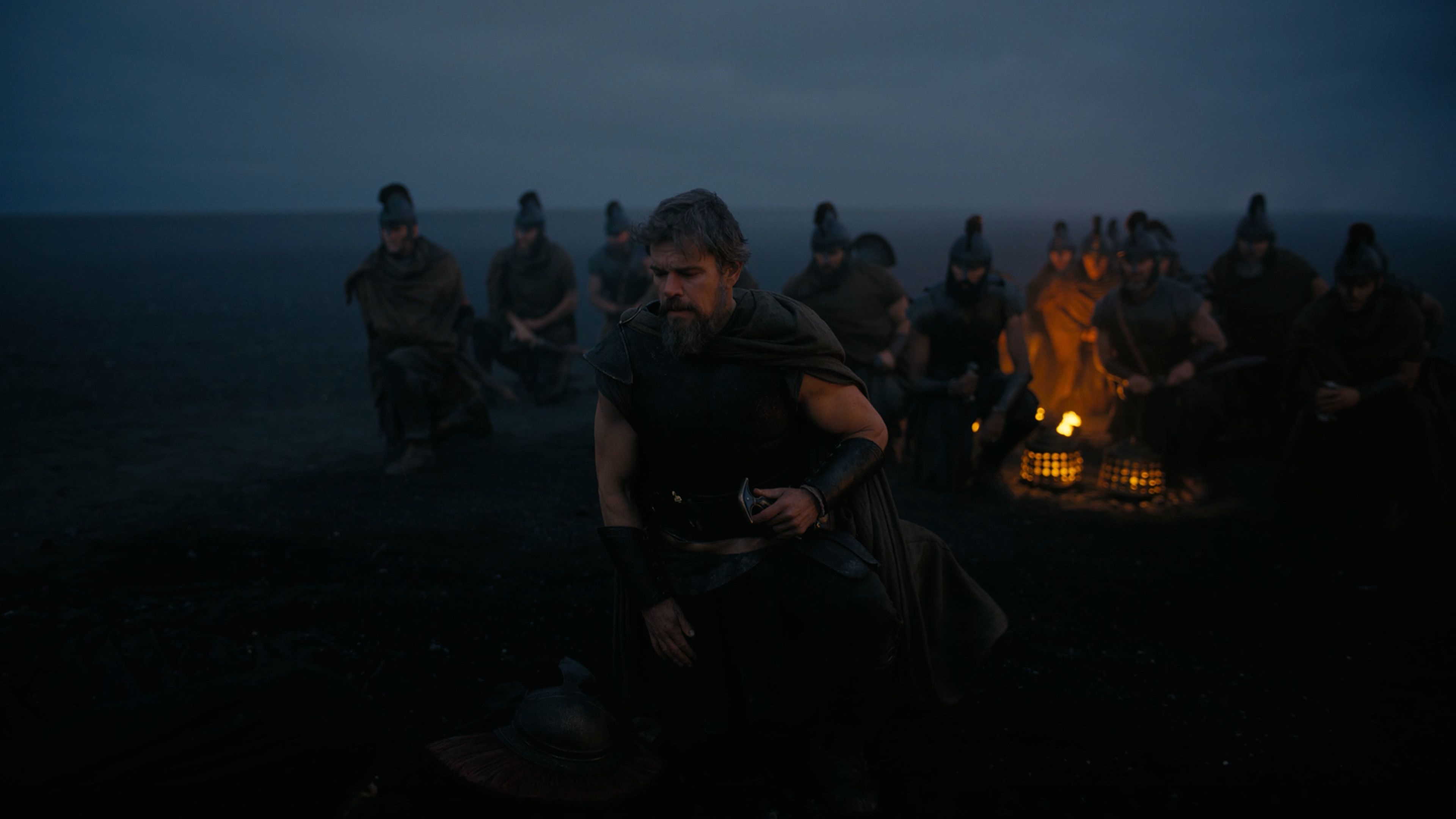
Production still © Universal Pictures, via TMDB.
Inside the Production
The shoot itself was a logistical undertaking on the scale of Nolan’s reputation. Principal photography ran 91 days between late February and early August 2025, across Morocco, Greece, Italy, Iceland, Scotland, Western Sahara and a soundstage at Universal’s Los Angeles lot, wrapping nine days ahead of schedule despite the sprawl. Aït Benhaddou and Essaouira in Morocco stood in for parts of the ancient Mediterranean; the Aeolian Islands off Sicily and the island of Favignana provided volcanic coastline; Iceland’s Hjörleifshöfði and the Snæfellsnes peninsula supplied otherworldly black-sand backdrops for the more surreal stretches of Odysseus’s journey. A cave on Malta doubled as Calypso’s island prison. The Western Sahara leg, filmed near a white dune outside Dakhla, drew protest from the Polisario Front and a number of Spanish actors and filmmakers over the disputed territory’s status, a controversy that trailed the production through its final months of shooting without derailing it.
Cinematographer Hoyte van Hoytema, reuniting with Nolan after Dunkirk, Tenet and Oppenheimer, shot on formats ranging from full 1.43:1 IMAX film down to 35mm depending on the sequence, meaning the aspect ratio itself shifts throughout the film — a choice that’s divided some viewers but that IMAX loyalists have largely embraced as the point of buying a 70mm ticket in the first place. Production designer Ruth De Jong and the effects team at Wētā Workshop leaned hard into practical craft: animatronics and prosthetics for the Cyclops Polyphemus, reportedly designed with Goya’s Saturn Devouring His Son as a visual reference point, forced-perspective and mismatched-height stunt performers for the Laestrygonians, and old-fashioned stage trickery layered under the digital work rather than replacing it. Scylla is one of the film’s few fully digital creatures, built by a team that has cited Guillermo del Toro’s creature-design instincts as a touchstone.
Ludwig Göransson’s score is its own small rebellion against expectation. Rather than the sweeping symphonic language most sword-and-sandal epics default to, Göransson built the soundtrack around bronze gongs layered with synthesizers, an actual ancient lyre and aulos, sheet-metal alarm drums, and field recordings of Albanian shepherds singing in the iso-polyphony folk tradition. The closing-credits song, “When I’m Home,” pairs Göransson with James Blake and Travis Scott — who also appears on screen in a small role as a wandering bard — with Nolan himself taking a co-writing credit. It’s an odd, distinctly modern needle-drop for a film built otherwise around ancient texture, and it’s exactly the kind of swing that either lands as inspired or gets singled out in every mixed review.
What Critics and Audiences Are Saying
The reception has been, on balance, closer to rapturous than anyone reasonably expected for a three-hour R-rated epic. The Odyssey currently sits at 94% on Rotten Tomatoes from over 500 reviews, with the site’s critics’ consensus reading: “Reinvigorating an ancient adventure with majestic sweep and sterling work by its colossal ensemble, Christopher Nolan’s The Odyssey imbues myth with primal human feeling.” Audience scores are running even higher, at 96% from tens of thousands of verified ratings, which is a rare instance of critics and general audiences landing on almost exactly the same page for a film this ambitious.
The praise hasn’t been uniform. The most consistent criticism, even from favorable reviews, targets Nolan’s fidelity to Homer — or rather his selective fidelity, since he’s described his own approach as “very faithful” to the source material while quietly restructuring and humanizing large stretches of it. Purists have objected to some of the costume and prop design, which mixes Bronze Age references with more fantastical, almost Nolan-Batman-adjacent armor on certain characters, and to dialogue that occasionally reads as too contemporary for characters meant to be speaking in the register of epic poetry. None of it has meaningfully dented the film’s commercial or critical momentum, but it’s shaped a genuine, ongoing conversation about what “faithful adaptation” is supposed to mean when the source text is a few thousand years old and has already been reinterpreted more times than anyone could count.
A separate, louder strand of criticism arrived before the film even opened and had nothing to do with craft. Casting choices, particularly Lupita Nyong’o as Helen of Troy and Elliot Page in a supporting role, drew backlash from a vocal corner of the internet, including a much-discussed public jab from Elon Musk accusing Nolan of “pissing on Homer’s grave.” Classical scholars pushed back fairly directly on the historical premise of the complaint, pointing out that Homer never actually describes Helen as fitting any specific physical archetype, let alone one tied to a particular casting standard. Separately, some Greek critics and audiences raised a more grounded point: a film built entirely around Greek mythology, shot in six countries, doesn’t feature a single major Greek actor in its principal cast, an omission that’s been debated in Greek press without derailing the film’s reception everywhere else.
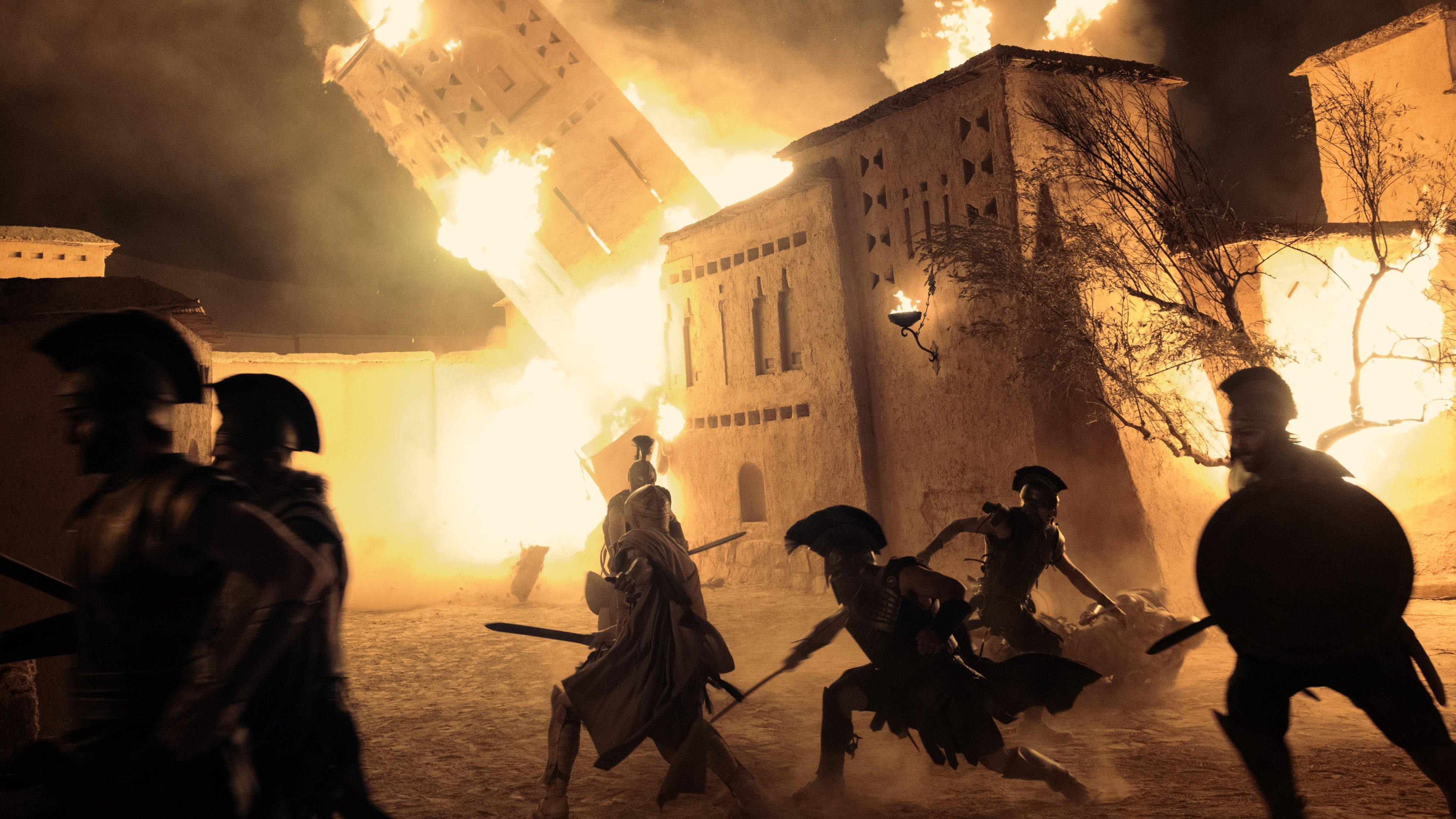
Production still © Universal Pictures, via TMDB.
The R-Rated Record, and What It Means for Original Filmmaking
Buried a little under the international box office headline is a second record that’s arguably just as significant for the industry: The Odyssey is now the highest-grossing R-rated film of all time, worldwide, surpassing Deadpool & Wolverine. That’s a genuinely unusual achievement for a film that isn’t a raunchy comedy or a comic-book property leaning into its rating for marketing shock value. The R here comes from what the BBFC’s own certificate describes as “strong violence,” alongside threat and horror sequences involving the film’s various monsters, infrequent strong language, brief implied sexual content, drug use, and graphic injury detail — in other words, a rating earned the traditional way, through an unflinching approach to a genuinely brutal, blood-soaked text, rather than bolted on for edge appeal.
Combine that with the original-story milestone and you get a film quietly making the case against two different pieces of received studio wisdom at once: that adult-skewing, harder-rated films can’t open wide enough to matter financially, and that audiences worldwide will only turn out in franchise-tentpole numbers for things they’ve already seen before in some form. Whether either lesson actually sticks is a separate question. Hollywood has a well-documented habit of treating a single outlier as proof of concept, greenlighting a wave of imitators, watching most of them underperform because they lack whatever specific alchemy made the original work, and concluding the lesson was wrong all along. Nolan’s name, his post-Oppenheimer Best Director Oscar, and a marketing budget most studios wouldn’t extend to an original project are all doing real, non-repeatable work here. Still, for at least one box office cycle, the theory that “big and original” is commercially dead is going to be much harder to say with a straight face.
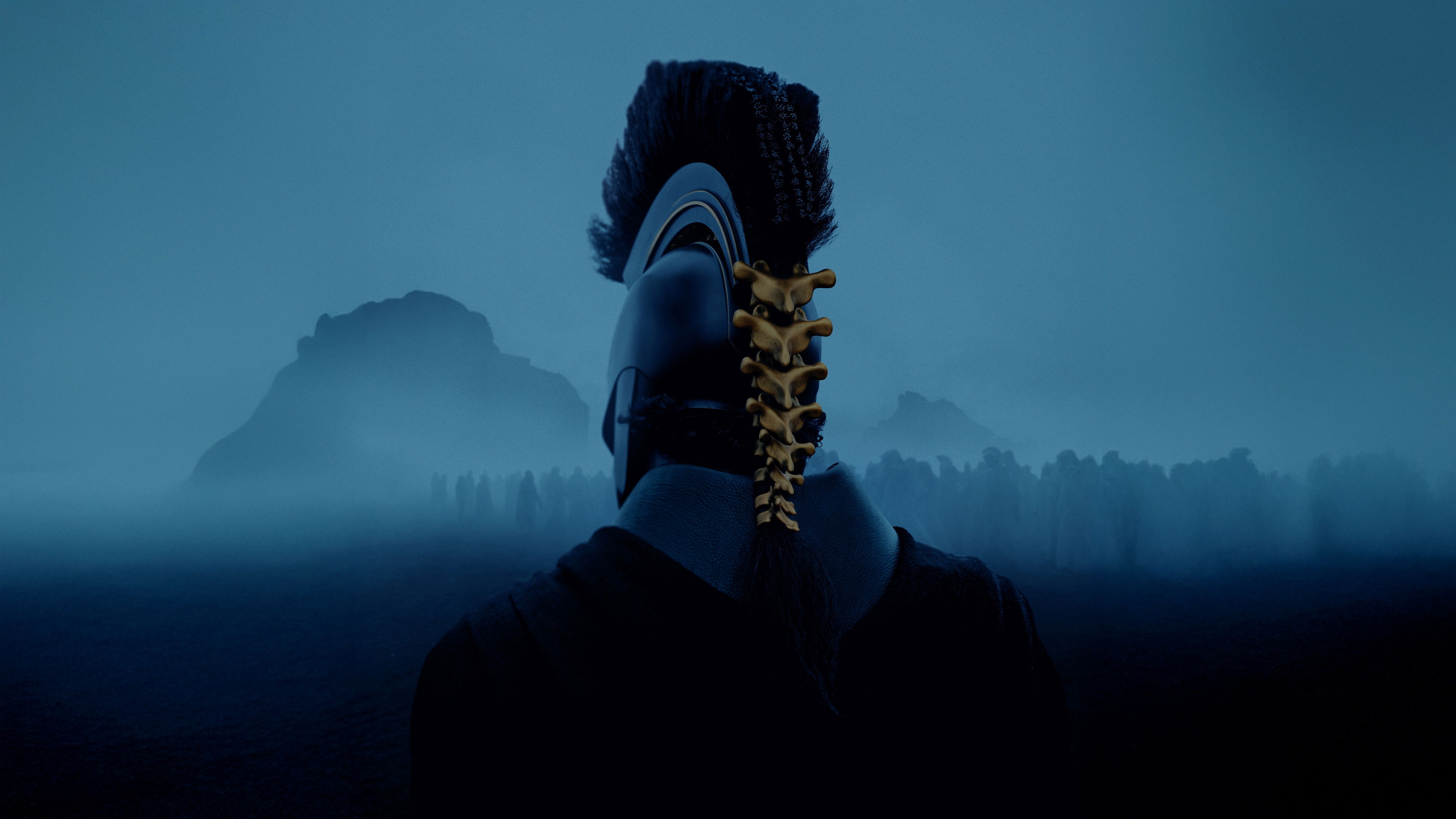
Production still © Universal Pictures, via TMDB.
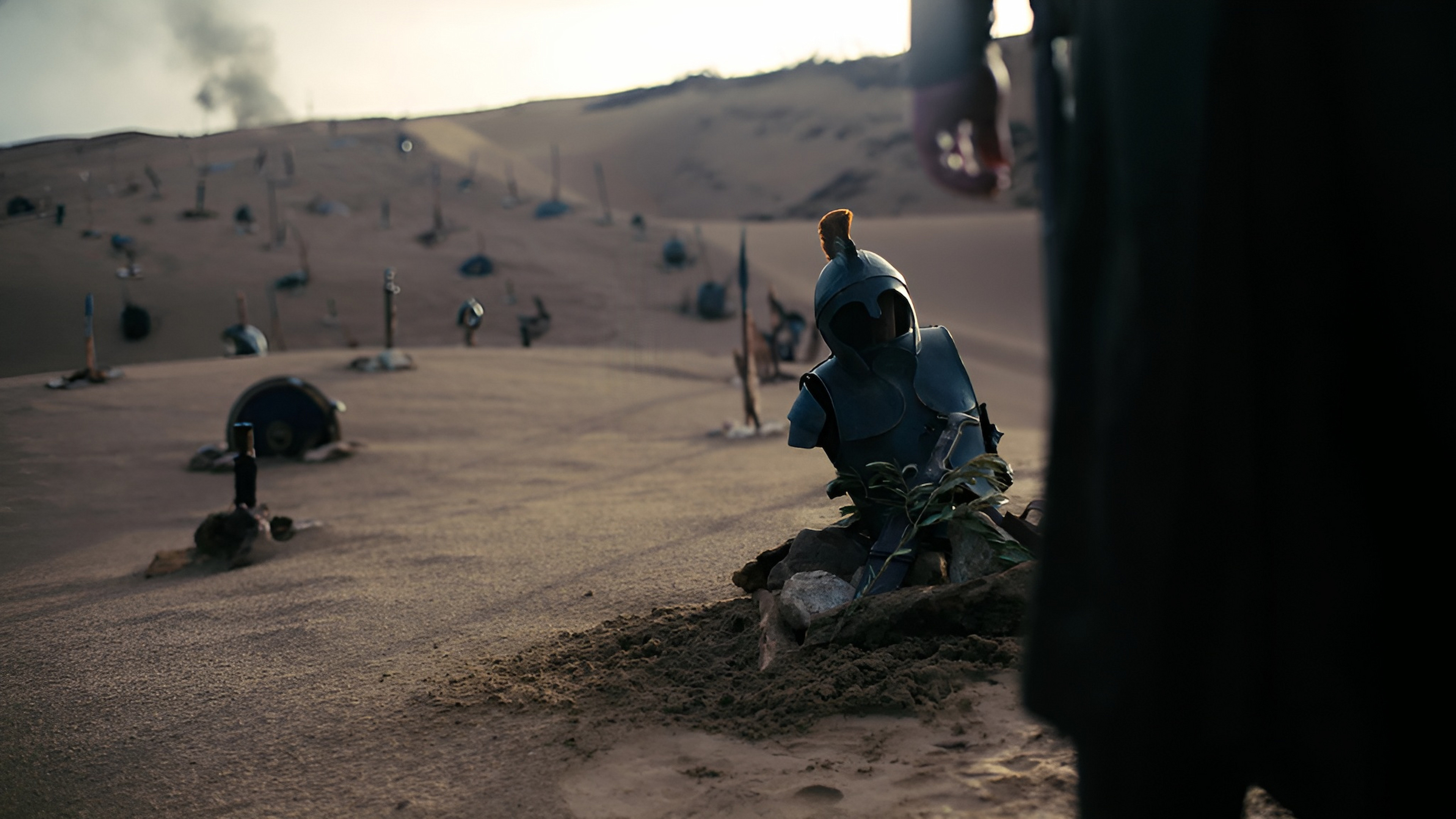
Production still © Universal Pictures, via TMDB.
Where This Leaves Nolan’s Filmography
It’s strange to talk about a director topping himself when the previous high point was an Oscar-sweeping Best Picture winner, but that’s roughly where The Odyssey leaves Christopher Nolan’s career arc. Oppenheimer proved he could make a three-hour, dialogue-heavy biopic about theoretical physics and nuclear guilt into a genuine box office event; The Odyssey proves the same appetite exists for a three-hour, R-rated myth with a body count, shot in a format almost nobody can actually project properly. Taken together, the two films make a fairly strong case that Nolan has quietly become the only filmmaker left who can reliably get an adult, original, big-swing production financed at true blockbuster scale, on his own terms, without leaning on an existing franchise to de-risk the greenlight.
That’s a strange kind of monopoly to hold in 2026, and not obviously a healthy one for the wider industry even as it’s clearly been good business for Nolan and for Universal. Every other studio still greenlighting nine-figure originals is doing it far more cautiously, usually with a recognizable IP hook, a built-in streaming safety net, or a budget a third of this size. Whether The Odyssey‘s success loosens that caution even slightly, or just gets filed away as further proof that this only works because it’s Nolan, is the more interesting long-term question hanging over the film’s record-breaking run.
What’s Next: Awards Season and Beyond
The box office chapter of this story isn’t finished, but attention is already turning toward what comes after the theatrical run empties out. Awards prognosticators had The Odyssey pegged as a likely Best Picture contender before a single ticket sold, on the strength of Nolan’s post-Oppenheimer standing alone, and the commercial and critical reception since July has only firmed that up. Early predictions circling the film cluster around the craft categories especially: cinematography for van Hoytema, score for Göransson, production design, costume and visual effects all look close to locks for nominations, with the bigger question being whether voters reward the film in the top categories the way they did Oppenheimer two years ago, or whether it ends up more of a technical-category juggernaut that comes up short in Best Picture and directing races the way Dunkirk did. Matt Damon and Anne Hathaway have both drawn some early acting-category chatter, though neither is being talked about as a frontrunner yet this far out.
On the release calendar, a 4K Ultra HD Blu-ray and digital release is currently set for November 17, 2026, roughly 120 days after the theatrical bow, which will be the first real opportunity for audiences outside the shrinking number of active 70mm engagements to see the film in anything resembling its intended presentation at home. Given how central the theatrical experience has been to this film’s identity and marketing, expect a genuinely elaborate home-video push, and no small amount of debate over whether any home format can meaningfully replicate what people have been queuing up for since last July. For now, though, the more immediate story is simpler: a three-hour, R-rated, $250 million bet on Homer just became the biggest movie of Christopher Nolan’s career, and the first wholly original story in seventeen years to prove a billion-dollar international audience for something with no built-in familiarity still exists, if a studio is willing to bet big enough on it.
Frequently Asked Questions
How much money has The Odyssey made worldwide?
As of this week, The Odyssey has grossed roughly $595 million domestically and $1.062 billion internationally, for a worldwide total of about $1.657 billion, making it Christopher Nolan’s highest-grossing film to date.
Why is The Odyssey crossing $1 billion overseas such a big deal?
It’s only the 17th film in history to reach $1 billion at the international box office, and the first original film (not a sequel, remake or reboot) to do it since James Cameron’s Avatar in 2009, a 17-year gap.
Is The Odyssey based on a true story?
No. It’s an adaptation of Homer’s ancient Greek epic poem The Odyssey, a work of mythology rather than history, following the warrior Odysseus’s ten-year journey home after the Trojan War.
Who plays Odysseus in the movie?
Matt Damon plays Odysseus. He’s joined by Tom Holland as his son Telemachus, Anne Hathaway as his wife Penelope, and a large ensemble including Zendaya, Charlize Theron, Lupita Nyong’o and Robert Pattinson.
How long is The Odyssey?
The film runs 173 minutes, just under three hours.
What is The Odyssey rated?
It’s rated R in the United States and 15 in the United Kingdom, primarily for strong violence, along with threat, brief strong language, implied sexual content and graphic injury detail.
Is The Odyssey suitable for kids?
Not really. Both the MPA’s R rating and the BBFC’s 15 certificate reflect fairly intense violence and horror elements, including creature attacks and bloody aftermath, so it’s aimed squarely at older teens and adults.
Where was The Odyssey filmed?
Production took place across six locations: Morocco, Greece, Italy, Iceland, Scotland and Western Sahara, plus soundstage work at Universal Studios in Los Angeles.
Why did Christopher Nolan shoot The Odyssey entirely on IMAX 70mm?
Nolan wanted the biggest possible image and sound presentation for the story’s scale. It’s the first feature ever shot entirely on IMAX 70mm cameras, using a newly built, lighter camera rig and more than two million feet of film.
Can I still see The Odyssey in IMAX 70mm?
Only on a limited number of the 41 specially equipped screens worldwide, and availability has been shrinking as the theatrical run winds down, so it’s worth checking with your local IMAX venue directly for current showtimes.
Is The Odyssey good? What do critics think?
Very well received. It holds a 94% critics’ score and a 96% audience score on Rotten Tomatoes, with reviewers praising Nolan’s direction, the ensemble cast and the film’s technical craft.
Why has The Odyssey been controversial?
Mainly over casting choices, including Lupita Nyong’o as Helen of Troy, which drew backlash from some corners online, and separately over the absence of Greek actors in principal roles despite the story’s Greek origins and extensive Greek and Mediterranean filming locations.
How faithful is the movie to Homer’s original poem?
Nolan has described his script as “very faithful” to Homer while restructuring the narrative and humanizing several characters and relationships. Some critics and classicists have pushed back on specific creative liberties, particularly around costume, tone and dialogue.
Who composed The Odyssey’s score?
Ludwig Göransson, who also scored Tenet and Oppenheimer for Nolan. He built the score around bronze gongs, an ancient lyre and aulos, and Albanian folk vocal traditions rather than a conventional orchestral sound.
Is there a song at the end of The Odyssey?
Yes. “When I’m Home,” a collaboration between Göransson, James Blake and Travis Scott (who also has a small on-screen role as a bard), plays over the closing credits, with Nolan sharing a co-writing credit.
What is the highest-grossing R-rated movie of all time now?
The Odyssey, which has overtaken Deadpool & Wolverine to become the highest-grossing R-rated film ever at the worldwide box office.
When can I watch The Odyssey at home?
A 4K Ultra HD Blu-ray and digital release is scheduled for November 17, 2026, about 120 days after its July theatrical release.
Is The Odyssey expected to win Oscars?
It’s considered a strong contender heading into awards season, particularly in craft categories like cinematography, score, production design and visual effects, with Best Picture and directing chances seen as more competitive.
How does The Odyssey compare to Avatar’s box office record?
Avatar was the last original (non-sequel) film to cross $1 billion at the international box office, back in 2009. The Odyssey is the first film without an existing franchise behind it to repeat that feat in the 17 years since.
What was The Odyssey’s budget?
Approximately $250 million, making it one of the more expensive productions of Nolan’s career, driven partly by the cost and logistics of shooting entirely on IMAX 70mm film across six countries.

Scott Allden Writer/Contributor @ Filmoria.co.uk
Scott, or Allden (Depending on which level of association you stand) is an avid film fan, comic reader, writer and video producer. Regularly and deftly expressing his disdain of modern film. But the way to his heart is through shared love of Coen Brothers movies, highly tensed thrillers and Star Wars.