
Ink Trailer 2: 13 Things to Know About Danny Boyle’s Rupert Murdoch Film Before Its 8 January UK Release
Movie News 10th November 2026 Jon Dingle
By the Filmoria News Desk
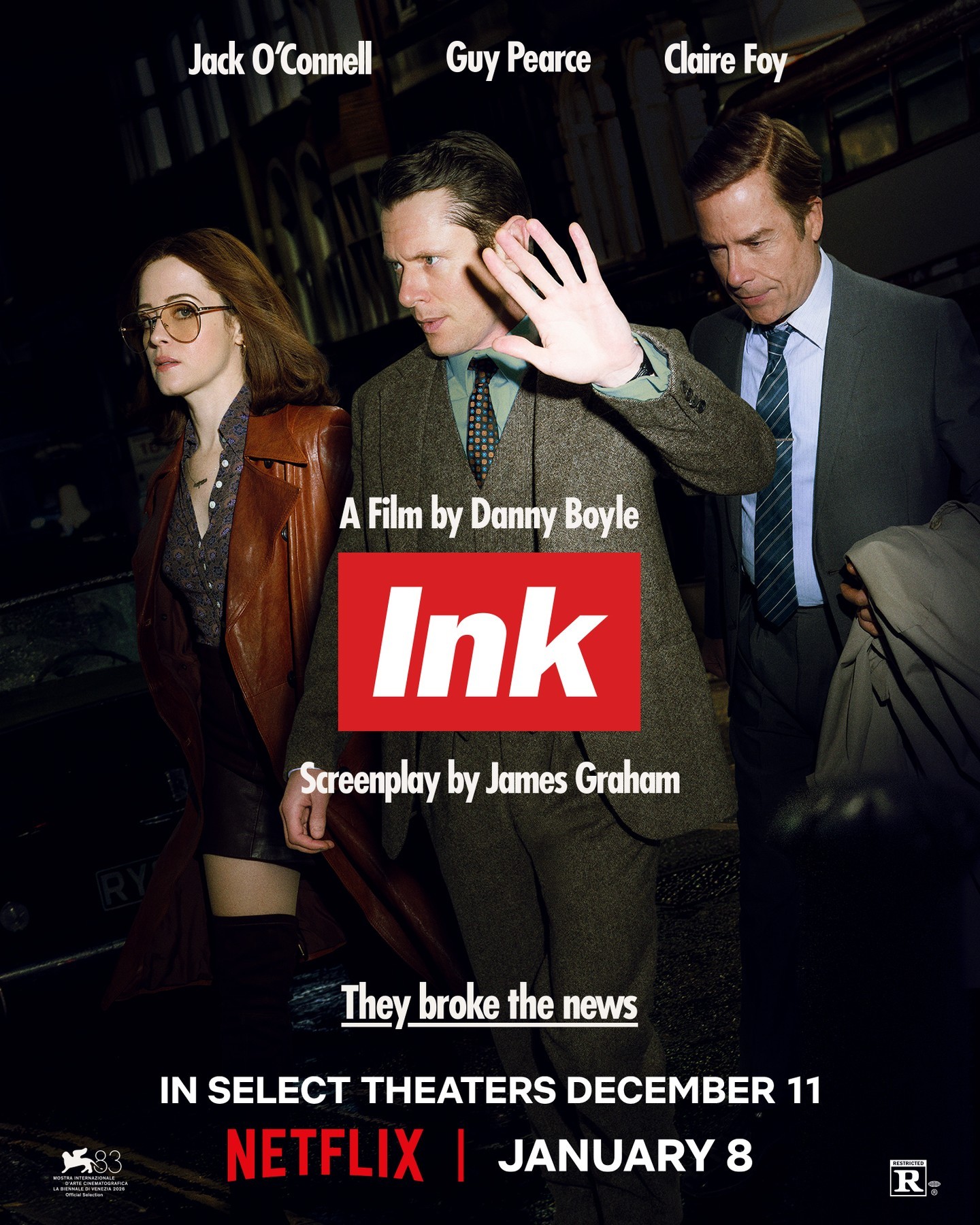
Netflix and Studiocanal released the second trailer for Ink, Danny Boyle’s film about how Rupert Murdoch and editor Larry Lamb turned The Sun into Britain’s biggest tabloid, on 10 November 2026. Jack O’Connell plays Lamb, Guy Pearce plays Murdoch and Claire Foy co-stars. The film opens in UK and Irish cinemas through Studiocanal on Friday 8 January 2027, the same day it starts streaming on Netflix in the US.
Quick Facts
- Title: Ink (2026)
- Director: Danny Boyle
- Writer: James Graham, adapting his own 2017 stage play
- Cast: Jack O’Connell (Larry Lamb), Guy Pearce (Rupert Murdoch), Claire Foy (Jules Davies), Blake Harrison, Patrick Kennedy, Angus Imrie, Brian Gleeson
- Runtime: 116 minutes
- Production: Studiocanal (fully financed), Media Res, House Productions
- World premiere: Opening night of the 83rd Venice Film Festival, 2 September 2026
- Latest news: Second trailer released 10 November 2026
In the UK
- UK cinema release: Friday 8 January 2027, in UK and Irish cinemas
- UK distributor: Studiocanal (Netflix holds the US and Latin American rights)
- UK streaming: not yet confirmed for the UK
- BBFC rating: not yet confirmed for the UK (the film is rated R in the US)
This is a numbered list of the 13 things you need to know about Ink now that its second trailer is out, from the release plan and the real story to the cast, the reviews, the AI row and the awards race. We’ve put the newest development first, then the details UK cinemagoers need, then the story and the people behind it, and finally how it’s landing with critics and voters.
| # | Item | Key date | Key fact | Status |
|---|---|---|---|---|
| 1 | Second trailer | 10 Nov 2026 | Released by Netflix and Studiocanal | Out now |
| 2 | UK release | 8 Jan 2027 | Studiocanal, UK and Irish cinemas | Confirmed |
| 3 | The real story | 1969 | Murdoch buys The Sun, hires Larry Lamb | Historical |
| 4 | Jack O’Connell | 2026 | Plays Sun editor Larry Lamb | Lead role |
| 5 | Guy Pearce | 2026 | Plays Rupert Murdoch | Lead role |
| 6 | Claire Foy and ensemble | 2026 | Foy plays Jules Davies | BIFA nominee |
| 7 | James Graham’s play | June 2017 | Almeida, West End, then Broadway in 2019 | Olivier and Tony winner |
| 8 | Boyle and his crew | 2026 | 116-minute runtime | Complete |
| 9 | Festival run | 2 Sep 2026 | Venice opening film, in competition | Venice, Telluride, TIFF, London |
| 10 | Critics | Sep to Nov 2026 | 73% on Rotten Tomatoes (66 reviews) | Mostly positive |
| 11 | The AI row | Sep 2026 | About 30 seconds of generative AI | Ongoing debate |
| 12 | Money and the Netflix deal | Aug to Oct 2026 | Budget: Not disclosed | Rights split |
| 13 | Awards | 6 Dec 2026 | BIFA nominations incl. Foy and production design | Winners pending |
1. The Second Trailer (10 November 2026, Netflix and Studiocanal)
What makes it stand out: It’s the first big push towards a January release, and it sells Ink as a fast, funny newsroom caper rather than a sober media drama.
Key data: Released on 10 November 2026 by Netflix and Studiocanal, following an earlier teaser, for a 116-minute film rated R in the US.
Why it matters: With Venice, Telluride, Toronto and London behind it, this trailer is how most UK audiences will meet the film for the first time.
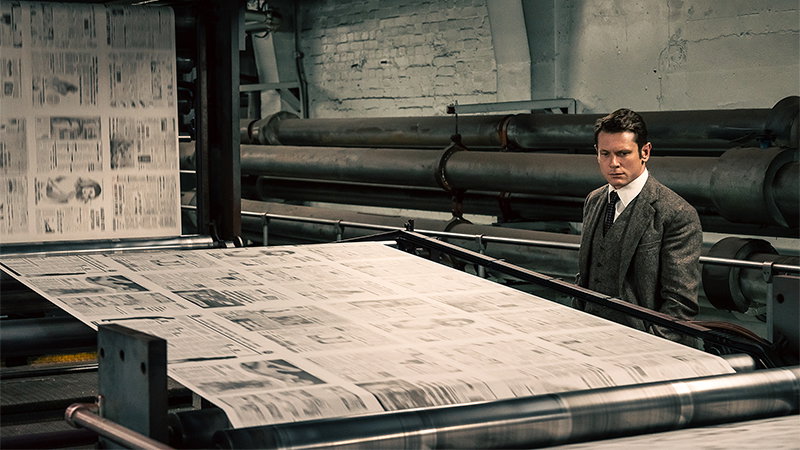
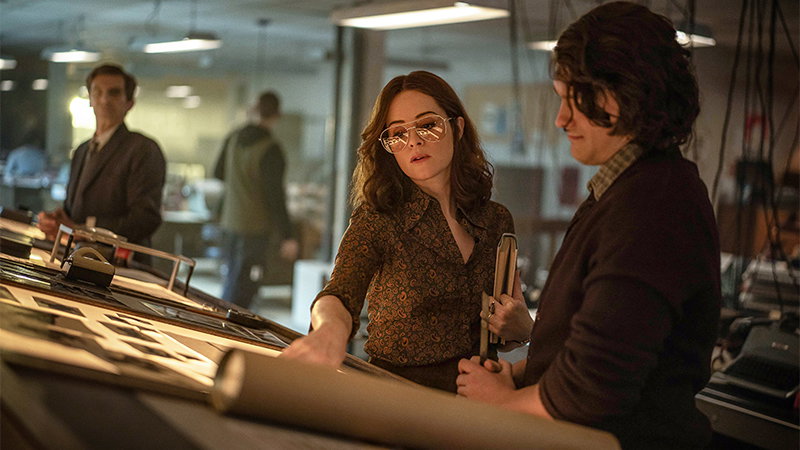
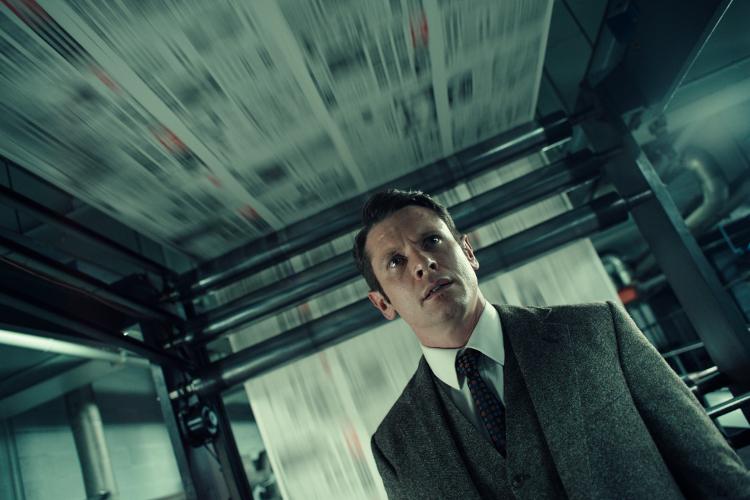
The new footage leans hard on energy. The stills Netflix and Studiocanal have put out with it show O’Connell’s Larry Lamb grinning behind the wheel of an open-top car, standing over the presses as the pages roll, and Claire Foy at a layout desk in the newsroom. It’s the pairing of Lamb and Pearce’s Murdoch that gives the campaign its spine: an ambitious editor with something to prove and an Australian outsider who’s just bought a failing paper.
Boyle’s own pitch is printed right into the marketing. As he puts it, “these two men created a new tabloid that, against all the odds, became the biggest-selling newspaper in the world.” That line is doing a lot of work. Ink isn’t framed as a takedown. It’s framed as an underdog story about people who happened to change British public life, and not always for the better.
FirstShowing’s Alex Billington, who premiered the trailer online, called it electric while admitting he dislikes the film’s use of AI (more on that below). That split reaction is a decent summary of where Ink sits right now: people who’ve seen it mostly enjoy it, and the arguments are about the edges.

2. The UK Release Date (8 January 2027, Studiocanal)
What makes it stand out: A film about a very British newspaper reaches British cinemas four weeks after American ones.
Key data: UK and Irish cinemas from Friday 8 January 2027 via Studiocanal; US limited cinema release from 11 December 2026, then Netflix streaming in the US from 8 January 2027.
Why it matters: UK audiences get a proper cinema release, but the timing clashes with the film’s US streaming debut.
The release plan is a little unusual. Netflix bought the film for the US and Latin America, so Americans get a limited cinema run from 11 December 2026, which keeps Ink eligible for the Oscars, followed by streaming on 8 January 2027. Studiocanal, which paid for the whole thing, is releasing it in cinemas in the UK, Ireland, France, Germany, Poland, Benelux, Australia and New Zealand, with Lucky Red handling Italy.
The catch is that the UK cinema opening and the US Netflix debut land on the same Friday. Film Stories pointed out that the overlap could frustrate Studiocanal, since a film that’s streaming in one big English-speaking market is easier to find through less legitimate routes in another. For UK viewers, though, the message is simple: if you want to see Ink in January, it’s a cinema trip. A UK streaming home hasn’t been announced, and the BBFC certificate isn’t confirmed yet either.
January is a sensible slot. It’s a crowded month for awards hopefuls, but Ink’s British subject gives it a home advantage, and it’ll still have to fight for screens with family films and holiday holdovers. If you’re planning further ahead, our guide to Narnia: The Magician’s Nephew and its 12 February UK release covers the next big date in the calendar.
3. The True Story Behind It (1969, The Sun)
What makes it stand out: It’s the origin story of the newspaper that shaped British tabloid culture for half a century.
Key data: Set in 1969, when Rupert Murdoch bought The Sun and handed it to editor Larry Lamb; the relaunched tabloid first hit newsstands on 17 November 1969.
Why it matters: Almost every UK viewer has an opinion about The Sun, which gives Ink a built-in argument before anyone’s bought a ticket.
In 1969 The Sun was a struggling broadsheet. Murdoch, then a young Australian newspaper owner building a foothold in Britain, bought it and gave it to Larry Lamb, a northern journalist who felt Fleet Street’s establishment had never taken him seriously. Their plan was blunt: give readers what they actually wanted, not what posh editors thought they ought to want. That meant sport, celebrity, sex, scandal, giveaways and a chatty, cheeky voice.
The relaunched tabloid appeared on 17 November 1969. Within a decade it had overtaken the Daily Mirror, the paper Lamb had been gunning for, and became the best-selling daily in the country. Venice’s official programme describes the story the same way: under Lamb, The Sun “became Britain’s best-selling tabloid, overtaking its rival, The Mirror.” The infamous Page 3 began a year after the relaunch, and Lamb was knighted in 1980.
The film covers the early, scrappy years, not the phone-hacking era decades later. That’s an important choice. Ink is about how the machine was built, and it lets the audience bring its own knowledge of where the machine ended up. Boyle has said he didn’t want to “monsterise” Murdoch, and the story’s structure is a big part of how he avoids it.
4. Jack O’Connell as Larry Lamb (Lead, Studiocanal)
What makes it stand out: Critics have singled out O’Connell’s Lamb as the best thing in the film.
Key data: O’Connell plays Lamb, The Sun’s first editor under Murdoch, who ran the paper for more than a decade.
Why it matters: After 28 Years Later and Sinners, this is O’Connell’s first true leading role in a major awards contender.
Rotten Tomatoes’ critics consensus sums it up: the film is “an erratic media indictment that’s ably anchored by Jack O’Connell’s superb performance.” That’s quite a thing to have printed under your name when the film’s other lead is Guy Pearce.
O’Connell has been building to this for years. Starred Up made his name in 2013, and he’s spent the last couple of years stealing scenes, first in Ryan Coogler’s Sinners and then for Boyle himself in 28 Years Later. Lamb gives him a different gear. He’s charming, chippy, funny and, by the end, a little frightening in how far he’ll go to win.
The trailer leans on that charm. You see Lamb in sunglasses behind the wheel of an open-top car with cheering women in the back, and you see him standing alone by the presses, looking like a man who’s just realised what he’s started. If the film has an emotional argument, it lives in the gap between those two images.
5. Guy Pearce as Rupert Murdoch (Lead, Studiocanal)
What makes it stand out: Pearce plays one of the most powerful living media owners in the world while Murdoch is still alive to watch it.
Key data: Pearce plays Murdoch as a young newspaper owner in 1969; he said Elisabeth Murdoch told him her father was pleased with the casting.
Why it matters: How the film handles Murdoch decides whether it plays as satire, tragedy or something more uncomfortable.
Pearce comes into Ink off an Oscar nomination for The Brutalist, and he’s playing a man most viewers think they already know. The trick, according to people who’ve seen it, is that this isn’t the Murdoch of Leveson. It’s an outsider with a funny accent, sneered at by the British establishment, who sees an opening and takes it.
That’s the version of Murdoch Boyle wanted. He has said the film doesn’t “monsterise” him. Pearce, for his part, told Australian press that Elisabeth Murdoch had said her father was pleased he’d been cast. Whether the real Murdoch will be as pleased with the finished film is another question entirely.
It’s worth remembering that two Australians, Pearce and Murdoch, sit at the centre of a film about British class anxiety. That’s a deliberate echo of the play, where Murdoch’s outsider status is the whole point: he’s not one of them, so he doesn’t care about their rules.
6. Claire Foy as Jules Davies and the Ensemble (Supporting Cast)
What makes it stand out: Foy’s Jules Davies is a newsroom insider and has already earned the film a BIFA acting nomination.
Key data: Foy plays Jules Davies, who works at The Sun; the wider cast includes Blake Harrison, Patrick Kennedy, Angus Imrie and Brian Gleeson.
Why it matters: Ink is an ensemble newsroom film, and the supporting players are what make The Sun feel like a real, chaotic workplace.
Foy is best known in the UK for playing the young Queen in The Crown, which makes her switch to a tabloid newsroom in 1969 a fun bit of casting. In the trailer she’s in tinted glasses, leaning over a layout desk with a page proof in hand. It’s a small glimpse, but it fits what reviewers have said about the film’s texture: lots of bodies, lots of noise, lots of people making it up as they go.
The ensemble is stacked with recognisable British faces. Blake Harrison is still best known to many as Neil from The Inbetweeners, while Brian Gleeson and Patrick Kennedy have long track records in British film and TV. That mix is very much in the spirit of Graham’s play, which built its drama around the misfits Lamb hired when no proper Fleet Street journalist would come near him.
Foy’s work has already paid off. She’s among the Best Supporting Performance nominees at this year’s British Independent Film Awards, which we’ll come back to.
7. James Graham’s Play (Almeida Theatre, 2017)
What makes it stand out: The source material was already a proven hit on both sides of the Atlantic before Boyle got involved.
Key data: Ink opened at London’s Almeida Theatre in June 2017, transferred to the West End’s Duke of York’s Theatre, then opened on Broadway in April 2019, winning one Olivier Award and two Tonys.
Why it matters: Graham adapted his own play, so the film has the writer who knows the story best behind it.
The stage version, directed by Rupert Goold, starred Bertie Carvel as Murdoch and Richard Coyle as Lamb in London. It earned four Olivier nominations and won one, Best Supporting Actor for Carvel, in 2018. On Broadway, at the Samuel J. Friedman Theatre, Carvel returned alongside Jonny Lee Miller as Lamb. The production got six Tony nominations and won two: Featured Actor for Carvel and Lighting Design for Neil Austin.
Graham has become one of the most in-demand writers in Britain since then, with Dear England on stage and Quiz and Sherwood on television. He’s credited as an executive producer on the film as well as writer, and Media Res, the company that optioned the play, is one of the production companies.
Turning a talky stage play into a cinema film is hard, and Boyle has been open that the theatrical origins put some backers off. More on the money in item 12. But it’s also why the film has such a strong structure. Graham’s play was built like a heist movie, with a team, a target and a deadline, and Boyle has leaned right into that.
8. Danny Boyle and His Crew (Director and Craft Team)
What makes it stand out: Boyle reunites with several past collaborators for his most British subject since the London 2012 opening ceremony.
Key data: Cinematographer Alwin H. Küchler, composer Daniel Pemberton, editor Fin Oates, production and costume designers Gareth Pugh and Carson McColl, casting by Gail Stevens and Rebecca Farhall; produced by Boyle, Tessa Ross, Michael Ellenberg and Tracey Seaward.
Why it matters: The craft team is a big reason reviews keep using words like dizzying and rip-roaring.
Küchler and Pemberton both worked with Boyle on Steve Jobs, another film built on fast talk and big egos in rooms, and you can feel that DNA in the trailer’s rhythm. Producer Tessa Ross, who ran Film4 for years, has backed a long run of British filmmakers, and the London 2012 opening ceremony Boyle directed is still the most widely seen piece of work about Britishness he’s ever made.
The design is getting attention, too. Gareth Pugh, better known as a fashion designer, shares production and costume design credits with Carson McColl, and the pair have a BIFA nomination for production design. The trailer’s colours, all ochres, browns and loud 1960s prints against dark industrial presses, show why.
Boyle’s last few films have been very different: Yesterday, then the 28 Years Later horror revival. Ink sits closer to Trainspotting and Slumdog Millionaire in tempo. One Venice critic called it his best since Slumdog, which won eight Oscars including Best Director. That’s the bar people will now hold it to.
9. Venice Opening Night and the Festival Run (2 September 2026)
What makes it stand out: Ink was picked to open the world’s oldest film festival, and it was Boyle’s first time there.
Key data: World premiere on 2 September 2026 in the Sala Grande at the 83rd Venice Film Festival, in competition, then Telluride, TIFF, the BFI London Film Festival and Mill Valley.
Why it matters: Opening Venice puts a film straight into the autumn awards conversation.
La Biennale announced Ink as its opening film in the summer, and Boyle was clearly thrilled. “I’ve been to the Biennale many times, but this is my baptism at the film festival,” he said, calling it “a huge honour to be in a city of such extraordinary art and opening this great festival with my new film INK.” Festival director Alberto Barbera thanked Studiocanal, Media Res and House Productions for the film.
From Venice, Ink went to Telluride and Toronto, the two other big autumn launchpads, and then home to the BFI London Film Festival in October. It’s an unusually busy route for a film that won’t reach UK cinemas until January, and it tells you how seriously its backers are taking the awards race.
The festival run also brought the film’s biggest controversy into the open, which we’ll get to in item 11.
10. What Critics Said (73% on Rotten Tomatoes)
What makes it stand out: Reviews are positive but not unanimous, with near-universal praise for O’Connell and some doubts about the film’s excess.
Key data: 73% on Rotten Tomatoes from 66 reviews at the time of writing; four stars from The Irish Times; 9/10 from Film Threat.
Why it matters: That’s a solid score, but it’s not the near-perfect rating that usually locks in a Best Picture campaign.
The praise is mostly for energy and performance. The Film Stage called Ink “a rip-roaring look at the rise of sensationalism.” TheWrap went with “dizzying,” and one Venice reviewer went as far as calling it Boyle’s best film since Slumdog Millionaire.
The doubts are fairly consistent, too. Some critics found the style overcooked, and The Hollywood Reporter felt the final payoff was a bit muted. World of Reel said the film starts electric, then loses steam. Rotten Tomatoes’ word “erratic” captures that mix: when Ink is firing, it’s a blast, but some critics think it hasn’t quite decided what it wants to say about the paper it’s celebrating.
For a January release, that’s not bad. Plenty of British crowd-pleasers have done well with mixed-to-positive notices when the central performance is this strong. Filmoria hasn’t reviewed Ink yet, so we’re reporting the consensus here rather than giving our own verdict.
11. The AI Row (Around 30 Seconds of Generative AI)
What makes it stand out: Ink is one of the first major prestige films whose director has openly admitted to using generative AI on screen.
Key data: Boyle said about 30 seconds of the film uses generative AI, including animating archive photographs and putting Margaret Thatcher’s face onto an actor; he did not ask the Thatcher estate for permission.
Why it matters: It’s become the film’s main talking point outside its reviews, and it’ll follow it into awards season.
After Venice, some viewers asked online whether AI had been used to bring historical images, including the Kray brothers and Thatcher, to life. Boyle confirmed it in an interview at Telluride: roughly 30 seconds, used for animating old photographs, a few brief shots of mice and replacing an actor’s face with Thatcher’s. He said showing the real former prime minister, not an impersonator, was “very important” to him, because she used to visit Lamb’s office late at night and “they drank whisky together.”
He’s defended it at every stop. At a TIFF Q&A he called the use minimal and responsible, saying it’s linked with VFX work, and at the London Film Festival’s industry forum he described AI as “a part of the toolbox that the visual effects companies use now,” adding that he’d used it “very sparingly” and been careful not to “replace anyone.” Film Stories reported he was heckled over it, and Screen International quoted him saying he’d use AI again because it’s “a no brainer.” On the Thatcher estate, he said it shouldn’t “have control over our ability to insist on ideas in art.”
Not everyone’s convinced. Some reviewers said the AI shots look poor, and the fact that the critic who premiered the trailer raised it shows the issue isn’t going away. In fairness, it’s a small part of a two-hour film, but in an industry still arguing about AI, small parts get big headlines.
12. The Money and the Netflix Deal (Studiocanal and Netflix)
What makes it stand out: One of Britain’s best-known directors says he struggled to fund a film with this cast.
Key data: Studiocanal fully financed Ink and handles worldwide sales; Netflix bought US and Latin American rights before the Venice premiere; the budget has not been disclosed.
Why it matters: It’s a sharp example of how hard it’s become to get grown-up, mid-budget British dramas made.
Boyle was strikingly candid at the London Film Festival’s industry forum. He said it was “very difficult to raise the money.” On Matt Belloni’s podcast The Town, he added: “We managed to get the money off StudioCanal but they didn’t give us enough money. They were brave.” He thinks the play’s stage origins scared some backers off, and he hinted at another kind of pressure, asking whether a film about a modern tech giant would be welcomed by the platforms that now carry so much of the news.
Netflix came in early. It took the US and Latin American rights ahead of the Venice opener, and Boyle has called the streamer “really good partners,” while adding that “there are pressures.” The split release means Ink gets proper cinema runs in Europe and Australia and an awards-qualifying US cinema run before it hits Netflix there.
It’s a similar playbook to Netflix’s other big autumn film with an unusual cinema plan, The Further Mis-Adventures of Cliff Booth, though Ink’s UK release sits with Studiocanal rather than Netflix.
13. Awards Buzz (British Independent Film Awards 2026)
What makes it stand out: Ink is already a BIFA contender and is set up for BAFTA and Oscar campaigns.
Key data: BIFA nominations announced on 3 November 2026 include Claire Foy for Best Supporting Performance and Gareth Pugh and Carson McColl for production design; craft winners are due on 24 November and the main ceremony is on 6 December at London’s Roundhouse.
Why it matters: BIFA and BAFTA voters tend to reward British stories about British institutions, and Ink is exactly that.
Ink wasn’t the BIFA leader. Simon Stone’s Elsinore, starring Andrew Scott, led with 12 nominations, followed by Clio Barnard’s I See Buildings Fall Like Lightning with eight and Ashley Walters’ Animol with seven. But Screen Daily noted Ink featured strongly in the craft categories, and the Foy nomination gives it a presence in the acting races as well.
The bigger prizes come later. The US cinema run from 11 December keeps it eligible for the Academy Awards, and the January UK release lands right in the thick of BAFTA voting. O’Connell looks like the film’s best shot at major individual recognition, given how consistently critics have praised him.
The AI debate could be a wildcard. Voting bodies are still working out their positions on generative AI, and a film whose director openly defends using it will get asked about it at every Q&A between now and February.
What Happens Next
The next dates to circle are 24 November, when the BIFA craft winners are revealed, 6 December for the main BIFA ceremony, 11 December for the US cinema release and 8 January 2027 for UK and Irish cinemas. Expect a BBFC certificate and UK press screenings before then, and probably a third push of marketing in the run-up to the BAFTA nominations. We’ll update this guide when the UK certificate and any UK streaming plans are confirmed.
Sources: FirstShowing (second trailer, 10 November 2026); La Biennale di Venezia (opening film announcement and credits); Film Stories (Netflix deal and UK release date); PA via The Irish News (Boyle on funding and AI); Rotten Tomatoes (critics score); BFI (BIFA 2026 nominations).
Frequently Asked Questions
When is Ink released in UK cinemas?
Ink opens in UK and Irish cinemas on Friday 8 January 2027, released by Studiocanal.
Will Ink be on Netflix in the UK?
A UK streaming release for Ink has not yet been confirmed. Netflix holds the US and Latin American rights and starts streaming the film in the US on 8 January 2027, while Studiocanal is releasing it in UK cinemas.
Who plays Rupert Murdoch in Ink?
Guy Pearce plays Rupert Murdoch in Ink, portraying him as a young Australian newspaper owner who buys The Sun in 1969.
Who was Larry Lamb, the editor played by Jack O’Connell?
Larry Lamb was the editor Rupert Murdoch hired to run The Sun after buying it in 1969. He turned it into Britain’s best-selling tabloid, ran the paper for more than a decade and was knighted in 1980.
Is Ink based on a true story?
Yes, Ink is based on the true story of Rupert Murdoch buying The Sun in 1969 and relaunching it as a tabloid with Larry Lamb as editor, as dramatised in James Graham’s 2017 play.
Was Ink a stage play first?
Yes. James Graham’s play Ink opened at the Almeida Theatre in London in June 2017, moved to the West End and reached Broadway in 2019, winning one Olivier Award and two Tony Awards.
Did Danny Boyle use AI in Ink?
Yes. Danny Boyle has said about 30 seconds of Ink uses generative AI, mainly to animate archive photographs, for brief shots of mice and to put Margaret Thatcher’s face onto an actor.
What age rating is Ink in the UK?
The BBFC rating for Ink has not been confirmed yet. In the US the film is rated R for drug use, graphic nudity, sexual content and language throughout.
Are the reviews for Ink good?
Mostly, yes. Ink has a 73 percent score on Rotten Tomatoes from 66 reviews, with critics widely praising Jack O’Connell’s performance while some find the film’s style erratic.
Has Ink been nominated for any awards?
Yes. Ink earned 2026 British Independent Film Award nominations including Best Supporting Performance for Claire Foy and production design for Gareth Pugh and Carson McColl, with winners announced on 24 November and 6 December 2026.
📸 Follow us on Instagram for daily film, TV & gaming news: @filmoriauk

Jon Dingle Editor
A film journalist, writer and a filmmaker in business for over 20 years. I am passionate about movies, television series, music and online games. When I'm not reviewing the latest releases, you'll usually find me deep in a retro gaming session or catching up on the newest prestige drama. I believe great storytelling deserves an honest take, whatever the screen it's on.