

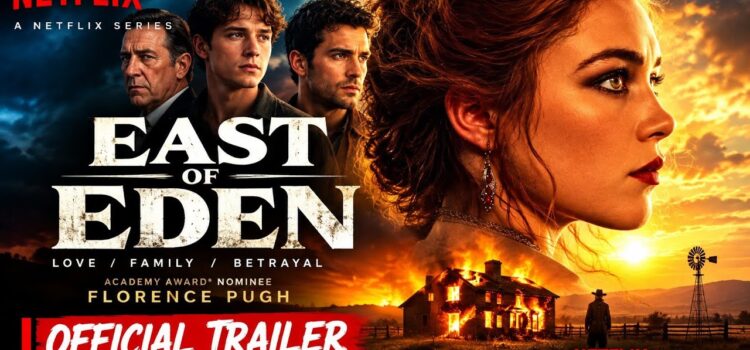
East of Eden Review: 11 Things That Decide Netflix’s Florence Pugh Epic
OTT Reviews 9th October 2026 Liz Bennett
Filmoria Review
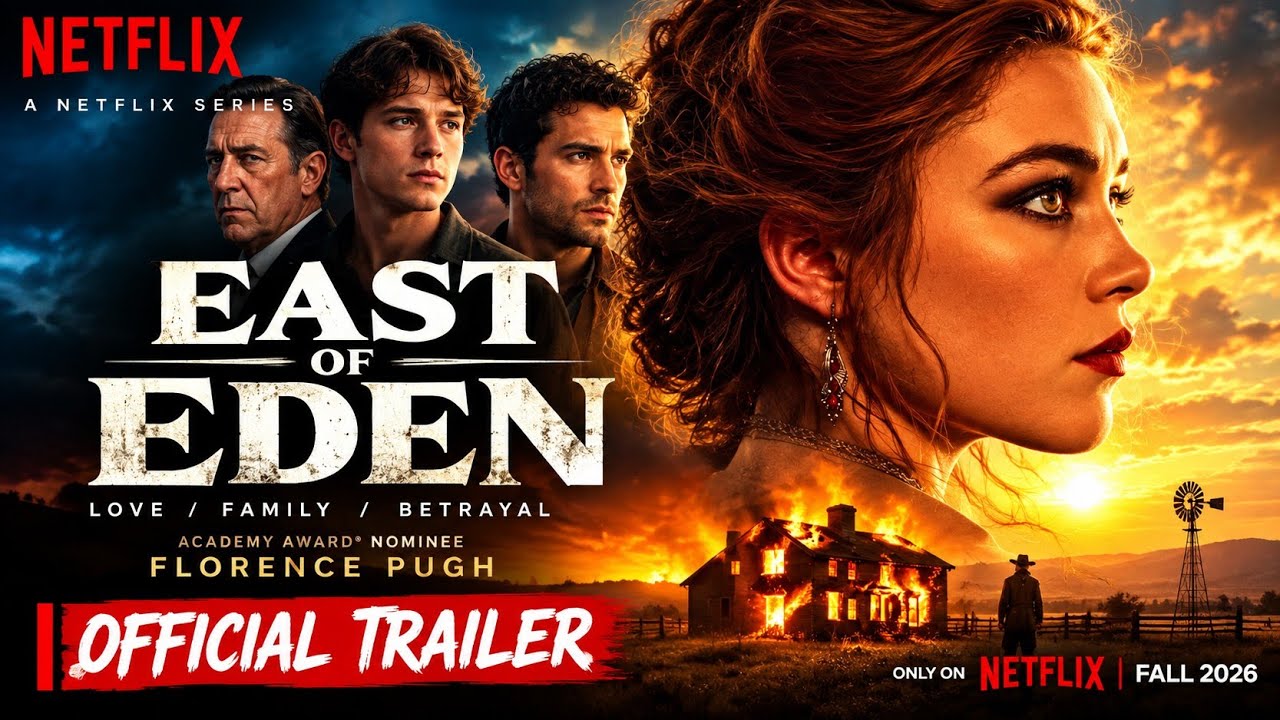
East of Eden (2026). Key art © Netflix, via the official trailer.
East of Eden is Netflix’s seven-episode adaptation of John Steinbeck’s 1952 novel, written by Zoe Kazan and starring Florence Pugh as Cathy Ames, and all seven episodes have been streaming on Netflix in the UK since 1 October 2026. Filmoria rates it 4 out of 5: Pugh gives the performance of her career and Hoon Lee quietly steals the show’s heart, but the decision to explain Cathy rather than fear her costs the series some of the novel’s terror, and seven hours still isn’t quite enough room for Steinbeck’s sprawl.
TL;DR: A handsome, serious, occasionally overstuffed retelling that turns Steinbeck’s monster into its main character. Florence Pugh is ferocious, Hoon Lee is wonderful, and the whole thing is worth seven hours of your autumn even when it wobbles.
Filmoria’s verdict: The best Steinbeck on screen since 1955, and the most frightening thing Florence Pugh has ever done.
Quick Facts
- Created and written by: Zoe Kazan (co-showrunner with Jeb Stuart), from the novel by John Steinbeck
- Directors: Garth Davis (episodes 1 to 4), Laure de Clermont-Tonnerre (episodes 5 to 7)
- Cast: Florence Pugh, Christopher Abbott, Mike Faist, Hoon Lee, Tracy Letts, Martha Plimpton, Ciarán Hinds, Joseph Zada, Joe Anders
- Episodes and runtime: 7 episodes, roughly seven hours in total, all released at once
- Platform: Netflix (UK and worldwide)
- Release date: Thursday 1 October 2026
- Rating: TV-MA (Netflix maturity rating)
In the UK
- UK release date: 1 October 2026, all seven episodes at once.
- Where to watch: Netflix UK, as a Netflix original; it is not available on any other UK service.
- Age rating: Netflix lists it as TV-MA; a BBFC certificate is not yet confirmed for the UK.
- Price: Included with every Netflix UK plan, with no extra rental or purchase fee.
This is a ranked breakdown of the eleven things that decide whether Netflix’s East of Eden is worth your time, covering the story, the performances, Zoe Kazan’s script, the direction, the pacing and how it measures up to earlier versions.
The items follow the order a verdict gets built: story first, then the actors, then the writing and craft choices behind them, then the comparisons, and finally who should watch. Filmoria’s ratings are our own, set against published reviews from the full seven-episode run, Netflix’s viewing figures and the confirmed production facts.
| Aspect | Filmoria Rating | Verdict |
|---|---|---|
| Story and premise | 4/5 | The whole novel, not just the last act, told from Cathy’s side |
| Florence Pugh (Cathy Ames) | 5/5 | Career best, and genuinely unsettling |
| Hoon Lee (Lee) | 4.5/5 | The show’s conscience and its warmest presence |
| The Trask men | 3.5/5 | Abbott and Faist are strong; the twins get squeezed |
| Zoe Kazan’s script | 4/5 | Bold restructuring, mostly earned |
| Cathy’s new backstory | 3/5 | Explains too much of what Steinbeck left terrifying |
| Direction and look | 4/5 | Painterly, patient, convincingly Californian |
| Pacing across 7 episodes | 3.5/5 | Superb opening half, crowded final stretch |
| Against earlier versions | 4/5 | Fuller than 1955, darker than 1981 |
| Overall | 4/5 | A must for Pugh fans and Steinbeck readers |
1. The Setup: Cathy Ames Comes to the Salinas Valley (2026, Netflix)
What makes it stand out: Instead of beginning with the Trask boys, as so many readers remember the story, the series follows Cathy Ames from childhood through her marriage to Adam Trask and her escape from it. Key data: Seven episodes released on Netflix on 1 October 2026, adapting Steinbeck’s 1952 novel across its full multigenerational span. Why it matters: It’s the first screen version to make the book’s villain its point of view, and that one choice reshapes everything else.
If you know the book, you know the bones. Adam Trask, a gentle, damaged man, marries a beautiful young woman with a hidden past and moves her to the Salinas Valley to build a kind of Eden. Cathy gives birth to twin boys, Cal and Aron, and then does something unforgivable. A generation later, the twins replay the Cain and Abel story their father and uncle lived before them.
Kazan keeps that spine, but she shifts the angle. Cathy narrates, she’s present in every episode, and the show is interested in her as a person who wants something, not just a force that wrecks things. That makes the opening hours feel fresh even to people who’ve read the novel twice. You’re watching a familiar story from the wrong side of the room.
It’s spoiler-light to say the second half belongs increasingly to Cal, and that the question hanging over him is the one Steinbeck cared about most: are we doomed to repeat our parents, or can we choose? The series takes that question seriously. It’s not a costume drama with a villain bolted on. It’s a family tragedy that wants an argument with you.
2. Florence Pugh’s Cathy Is the Performance of Her Career (Lead, Cathy Ames)
What makes it stand out: Pugh plays one of American literature’s great monsters without asking for your sympathy and without letting you look away. Key data: Pugh stars and executive produces; her Cathy has been called “career best” by The A.V. Club and Esquire, and she anchors every one of the seven episodes. Why it matters: The whole adaptation is built on her, and if she didn’t work, nothing else would.
She does work. Pugh has always had a gift for letting you watch someone think, and here she turns it into something cold. Cathy is constantly calculating, reading a room, deciding who to be in it. Variety’s review describes her as a character always recalculating as her position shifts over decades, and that’s exactly what you see: tiny adjustments of face and voice, a smile that arrives a beat late.
The Hollywood Reporter’s Dan Fienberg wrote that Cathy is so determinedly wicked she makes Becky Sharp look like a Girl Scout. We’d go further. Pugh’s best trick is that she’s often funny, and the laughs make it worse. You catch yourself enjoying her and then remember what she’s capable of.
TheWrap argued that Pugh plays Cathy as a cunning fighter for her own independence as much as a villain, and that’s true of the early episodes. Later, once Cathy has found her power, the performance gets scarier and stiller, and Pugh finds menace in quiet rather than volume. NME called her “consistently stupendous”. It’s hard to argue.
3. Hoon Lee’s Lee Is the Show’s Beating Heart (Supporting, Lee)
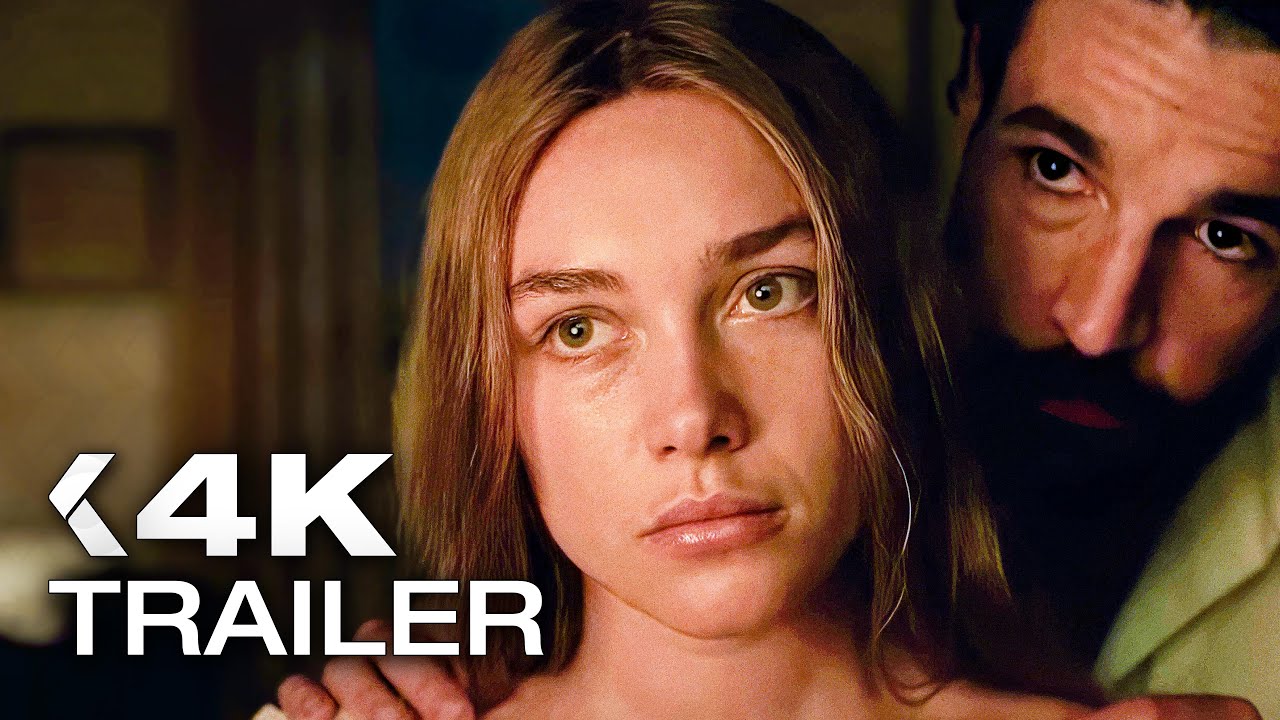
A frame from the East of Eden teaser trailer. Image © Netflix.
What makes it stand out: Lee, the Trask family’s Chinese American cook and the twins’ real parent in all but name, gets the richest supporting role in the series. Key data: The character was cut entirely from Elia Kazan’s 1955 film; Hoon Lee, known for Banshee and Warrior, plays him across the whole run. Why it matters: Lee carries the novel’s moral argument, and restoring him restores the book’s soul.
Variety’s review headline put Pugh and Hoon Lee together as the “beating heart” of the series, and if anything that undersells him. Lee is the person in the house who reads, listens and thinks. He’s the one who works through the meaning of timshel, the Hebrew word Steinbeck built the novel around, which Lee reads as “thou mayest”: the idea that people can choose good over evil.
The danger with Lee has always been that he becomes a wise helper with no inner life. TheWrap’s critic noted that Kazan expands his story while Hoon Lee keeps him real enough to mostly move past “Magical Asian” clichés. That’s fair. He gets his own history, his own loneliness and a dry wit that cuts through the show’s heavier moments.
Where we part company slightly with the raves is in the balance. Variety observed that the show’s twin portraits of Cathy and Lee aren’t consistently or equally successful, and Lee does arrive in focus more slowly. His big scenes are mostly in the back half. But when they come, they’re the moments you’ll remember. If Pugh is the reason to start this show, Hoon Lee is the reason to finish it.
4. The Trask Men: Abbott, Faist and Letts
What makes it stand out: The series surrounds Pugh with three of the most interesting American character actors working today. Key data: Christopher Abbott plays Adam Trask, Mike Faist plays his volatile brother Charles, and Tracy Letts plays their father Cyrus; Joseph Zada and Joe Anders play the twins Cal and Aron. Why it matters: Cathy is only as frightening as the men she destroys are believable.
Abbott is very good as Adam, which is a thankless job. Adam is decent to the point of blindness, and Abbott plays that goodness as a kind of wound rather than weakness. You understand why Cathy can see straight through him, and you feel for him anyway.
Faist is the electric one. Charles is jealous, violent and smarter than he looks, and Faist, who broke out in Steven Spielberg’s West Side Story and Challengers, gives him a coiled physicality that makes every family dinner feel dangerous. Letts, meanwhile, makes Cyrus a believable fraud in just a handful of scenes.
The problem is time. The A.V. Club’s main complaint was that a terrific supporting cast is sparse in its appearances, and we agree. Ciarán Hinds is lovely as Samuel Hamilton but barely there, and Martha Plimpton’s brothel keeper is the kind of role you wish had an extra episode. Zada and Anders, as the next generation, have to establish Cal and Aron in a fraction of the time Abbott and Faist got, and the compression shows. Cal, the novel’s real protagonist in its final stretch, deserved a little more room.
5. Zoe Kazan’s Script Takes Real Risks
What makes it stand out: Kazan, an actor and playwright best known on screen for The Big Sick and She Said, adapted the entire novel herself and rebuilt it around its most notorious character. Key data: Netflix first announced the limited series in 2022; Kazan wrote all seven episodes and serves as executive producer and co-showrunner with Jeb Stuart, the writer of Die Hard and The Fugitive. Why it matters: This is a writer’s show, and its biggest strengths and weaknesses both come from the page.
There’s an obvious family story here. Zoe Kazan is the granddaughter of Elia Kazan, who directed the famous 1955 film with James Dean. That film adapted only the last part of the book. His granddaughter has done the whole thing, and she’s done it on her own terms.
The cleverest move is structural. By letting Cathy narrate and keeping her present throughout, Kazan solves the novel’s biggest adaptation problem: in the book, Cathy disappears for long stretches and the story can feel like two novels stitched together. Here, she’s the thread. The Playlist called the result emotionally intelligent in its handling of family history, and the dialogue does have a playwright’s ear. Characters talk in full, thoughtful sentences without sounding like they’re reading Steinbeck aloud.
The cost is the Hamilton family. Samuel Hamilton’s sprawling clan, a big part of the book’s warmth and of Steinbeck’s own family history, is cut right back. Readers who love those chapters will miss them. We think Kazan made the right trade, but it is a trade.
6. The Backstory Problem: Should Cathy Be Explained?
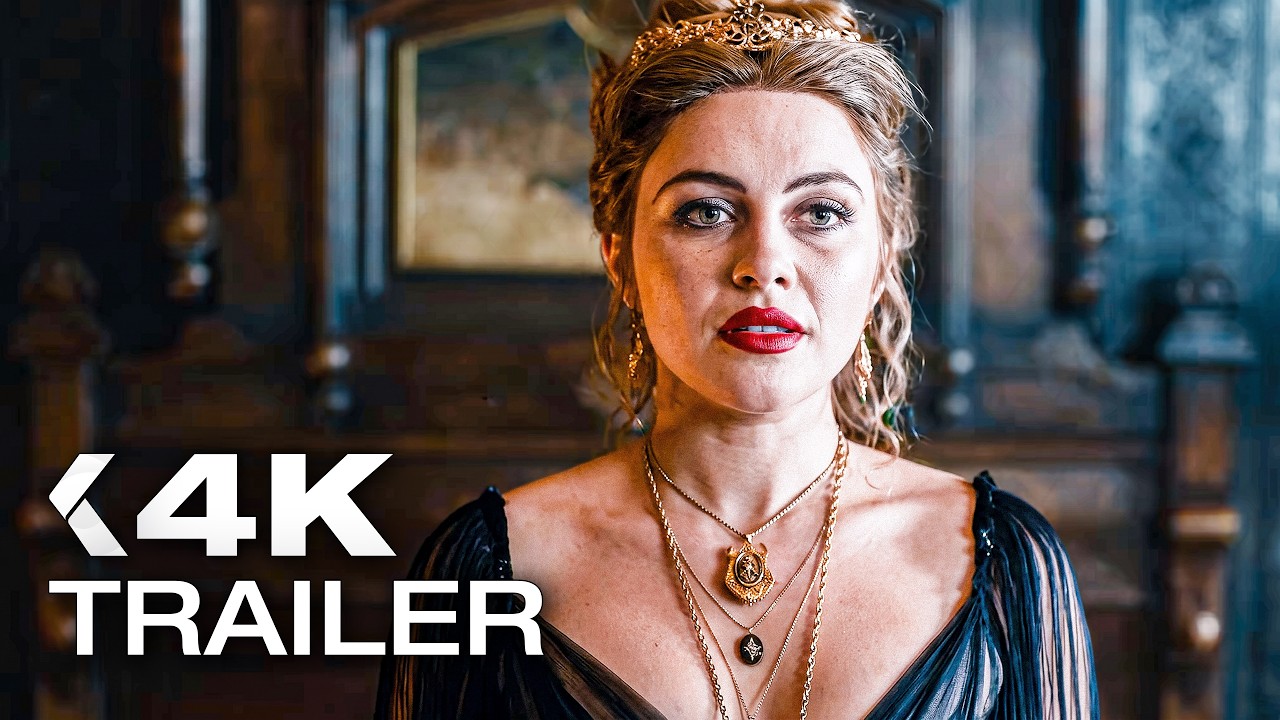
A frame from the official East of Eden trailer. Image © Netflix.
What makes it stand out: The series gives Cathy an abusive, misogynistic father and makes an early encounter in her life an explicit sexual assault, where the novel leaves her origins deliberately opaque. Key data: Steinbeck describes Cathy as born without a conscience; Kazan has said she found the book’s version more open to interpretation than Steinbeck may have intended. Why it matters: It’s the single biggest change in the adaptation, and the one critics argue about most.
The Wall Street Journal’s critic argued that Kazan loses some of her boldness by giving a trauma origin to a character Steinbeck wrote as evil by nature. On this one, we mostly agree with the Journal.
Kazan’s instinct is understandable. A 21st-century show about a woman who uses men isn’t going to pretend those men are all innocent, and the early episodes do make a sharp point about how few doors were open to someone like Cathy. Pugh plays that rage brilliantly.
But the novel’s Cathy is frightening because she can’t be explained. She’s a test case for the book’s big question: if some people are simply born wrong, what does that mean for the rest of us and our freedom to choose? Give her a reason, and the question gets smaller. It becomes a story about damage, which is true and sad, rather than a story about evil, which is stranger and more terrifying.
It doesn’t sink the show. Pugh never lets Cathy become a victim, and by the later episodes, the backstory has faded into the background. It just means this East of Eden is more humane and slightly less haunting than the book.
7. Garth Davis and Laure de Clermont-Tonnerre Make It Look Like an Epic
What makes it stand out: Two directors with very different strengths split the series in half, and the handover is smoother than you’d expect. Key data: Garth Davis (Lion, Top of the Lake) directed episodes 1 to 4 and is an executive producer; Laure de Clermont-Tonnerre (The Mustang) directed episodes 5 to 7; the series was filmed in New Zealand from late 2024, standing in for California’s Salinas Valley. Why it matters: A story this big needs a sense of land and time, or it shrinks into a stage play.
Davis made his name on landscape and atmosphere, from the Tasmanian bush of Lion to the New Zealand lakes of Top of the Lake, and that eye suits the first half, where the Trask farm is meant to feel like a promise already going sour. Reviewers have singled out the cinematography as one of the show’s real pleasures, and it’s easy to see why.
De Clermont-Tonnerre takes over as the story moves to the next generation and to Salinas itself. Her debut feature, The Mustang, was a close, character-first drama about a damaged man, and that sensibility suits the shift towards Cal and Aron, and Cathy’s later life, which is lived mostly behind closed doors.
New Zealand is a convincing California. Reports say the location was chosen to keep the budget under control, and you’d never guess. Critics have been near-unanimous that the production is handsome, and Variety credited the stellar cast and production with making the case for the story even where the writing falters.
8. Pacing: A Superb First Half and a Crowded Finish
What makes it stand out: Seven hours sounds like a lot, but it’s tight for a 600-page novel that spans more than 50 years. Key data: Seven episodes of roughly an hour, all released on 1 October 2026; RogerEbert.com’s review noted that even a seven-hour runtime isn’t enough to cover every plot beat. Why it matters: For a binge release, the shape of the whole run decides whether people finish it.
The Garth Davis half is where the show is most assured. It has the most room, it has Cathy and Adam’s marriage at its centre, and that slow burn plays almost like a thriller.
The back half has more to do and less room to do it. The twins have to grow up quickly, a whole generation of story has to fit into three episodes, and RogerEbert.com’s point about running out of time bites hardest here. Lee’s expanded role is what holds this stretch together. But you can feel the show rushing to fit everything in.
Our advice: give it at least two episodes before deciding, because the early hours are built as a slow burn. And don’t feel obliged to binge it. This is heavy material, and it plays better with a little breathing room.
9. How It Compares: Elia Kazan’s 1955 Film and the 1981 Miniseries
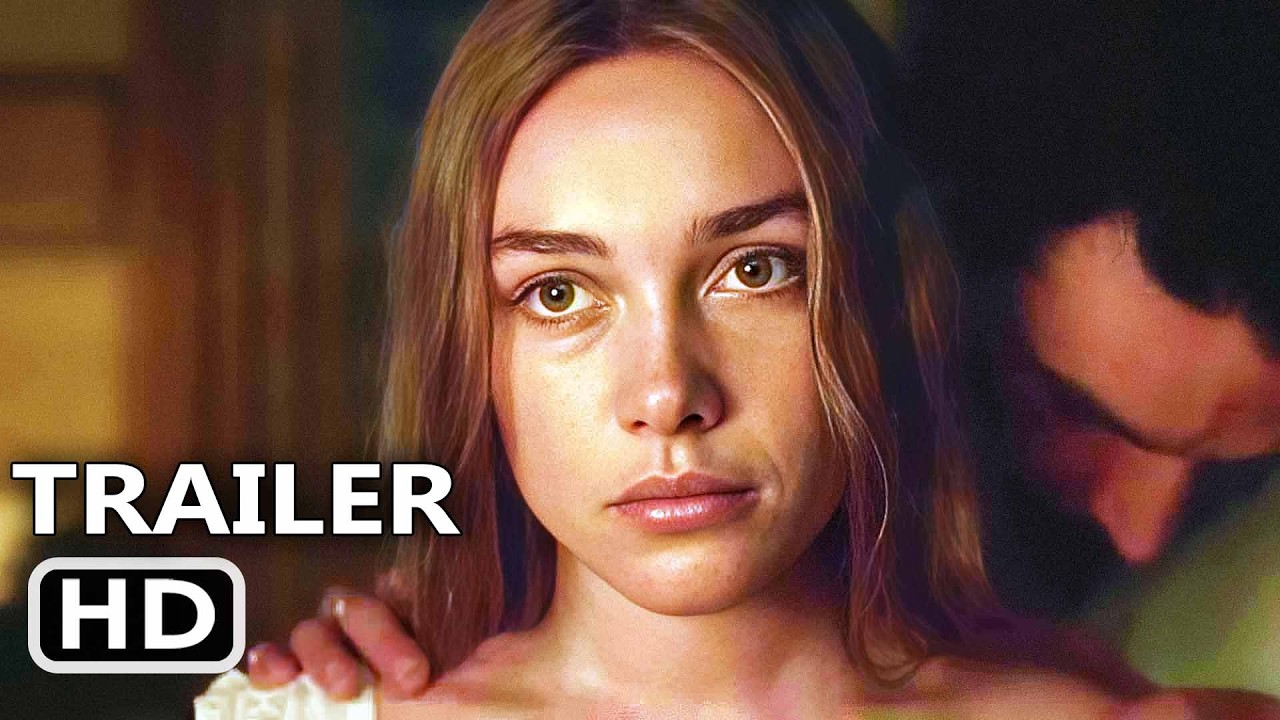
A frame from the official East of Eden trailer. Image © Netflix.
What makes it stand out: This is the third major screen version of the novel, and the first to treat Cathy as the lead. Key data: Elia Kazan’s 1955 film starred James Dean as Cal in his first major role and adapted only the novel’s final section; ABC’s 1981 miniseries starred Jane Seymour as Cathy; reported Rotten Tomatoes scores for the 2026 series have sat in the mid to high 80s, a couple of points above the 1955 film. Why it matters: Anyone weighing up seven hours will want to know whether this beats what’s already out there.
The 1955 film is a masterpiece of a different kind. It’s essentially a two-hour story about a son desperate for his father’s love, built around James Dean’s raw, twitchy performance. It cut Lee entirely and kept Cathy, as Kate, mostly at the edges. As a film, it’s iconic. As an adaptation of the whole book, it barely tries.
The 1981 miniseries tried harder, and Jane Seymour’s Cathy is still remembered. But it’s very much a network TV production of its time: lush, soapy and fairly safe.
Netflix’s version is the most complete and the darkest of the three. It doesn’t have a James Dean moment, and nobody will remember Zada’s Cal the way they remember Dean’s. But as a reading of the novel, it’s the richest by some distance. If you’ve only seen the film, this will feel like discovering a much bigger, stranger book hiding behind it.
Among recent streaming adaptations, it sits alongside Netflix’s Ripley as proof that literary classics can work on streaming when the people making them trust the audience’s patience.
10. Is It a Hit? Viewing Numbers and the Steinbeck Bounce
What makes it stand out: The series topped Netflix’s English TV chart in its opening week, though not by the margin of the streamer’s biggest launches. Key data: 6.5 million views in its first four days (week of 28 September to 4 October 2026), No. 1 on Netflix’s global English TV list; Deadline noted it was the lowest total for a No. 1 show since late March; sales of Steinbeck’s novel have risen nearly 200% since Netflix greenlit the series, according to Penguin figures reported by Variety. Why it matters: Prestige literary drama is a hard sell on Netflix, and these numbers will shape whether more get made.
A No. 1 debut is a No. 1 debut, but context matters. A dense period drama with no franchise attached was never going to open like a thriller or a true-crime series, and four days is a short window. Shows like this often build through word of mouth, especially once the reviews are out.
The book sales are the nicer story. A near-200% jump for a 74-year-old classic means people are going back to Steinbeck, and the show deserves some credit for that. Pugh and Kazan made a round of promotional stops in New York, Washington DC and Los Angeles ahead of launch, and the literary angle was clearly part of the pitch.
We’d be surprised if this didn’t climb in its second and third weeks. Either way, it’s a limited series. There’s no season two to wait for, which makes it an easier recommendation for anyone wary of starting another show that might never end.
11. Who Should Watch It, and Filmoria’s Final Verdict
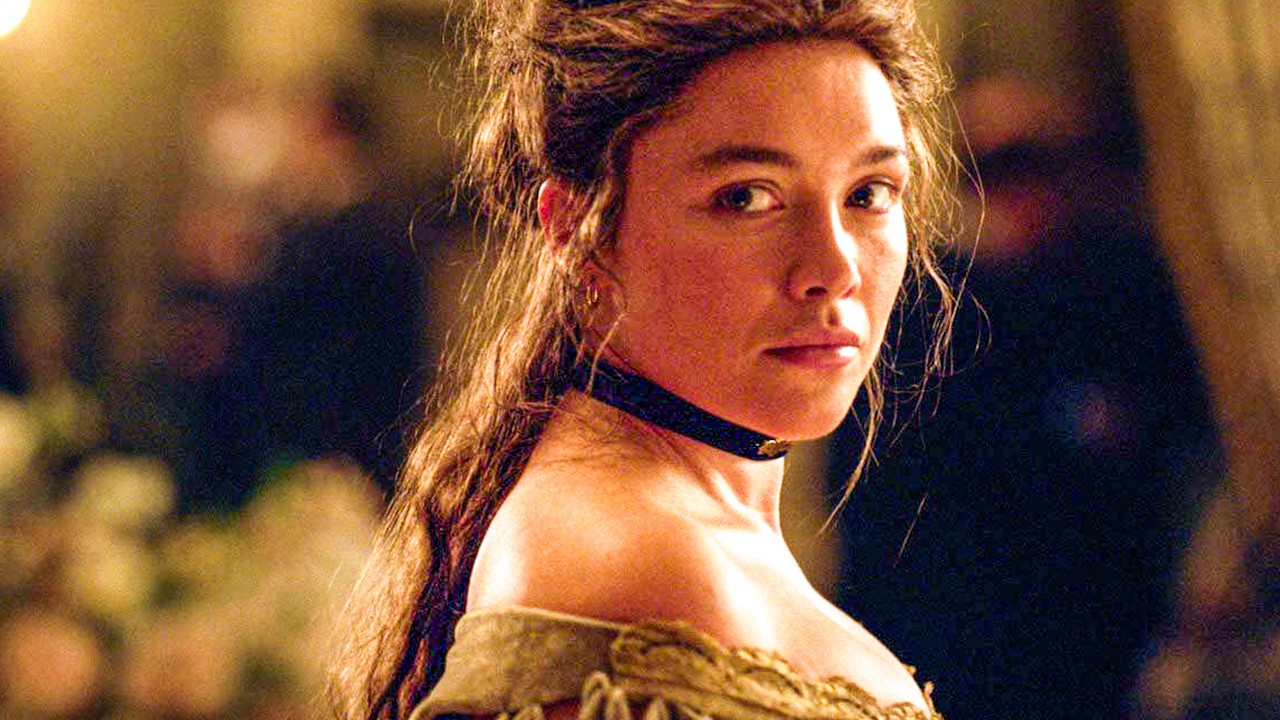
A frame from the official East of Eden trailer. Image © Netflix.
What makes it stand out: It’s the rare streaming drama that’s both a showcase for a star and a serious reading of a serious book. Key data: Filmoria rates it 4 out of 5; critics have broadly agreed, with TheWrap, NME, The A.V. Club, Variety and The Playlist all positive, and reservations centred on the backstory changes and the crowded back half. Why it matters: It’s seven hours of your time, and you should know before you start whether it’s for you.
Watch it if you’ve read the novel and want to see it done properly, if you’ve followed Florence Pugh since Lady Macbeth and want to see her at full power, or if you liked Ripley and want another patient, adult literary adaptation to sink into on dark autumn evenings.
Skip it if you want the 1955 film’s romantic tragedy and James Dean energy, or if you’re after a quick, light binge. This is long, it’s heavy, and it contains sexual violence and cruelty that some viewers will find hard going. Netflix’s TV-MA rating is there for a reason.
Filmoria’s verdict is 4 out of 5. East of Eden is ambitious, beautifully made and anchored by a towering lead performance, with Hoon Lee giving the show the moral centre it needs. Its decision to give Cathy a reason softens the book’s central mystery, and its final episodes are squeezed, which keeps it short of a masterpiece. But it’s the most complete version of Steinbeck’s novel ever filmed, and it’s very hard to stop watching once Pugh has her hooks in you.
The Bottom Line
Seventy years after Elia Kazan made James Dean a star with the last act of East of Eden, his granddaughter has taken on the whole book and turned it inside out. Making Cathy Ames the centre of the story was a big gamble, and it pays off because Florence Pugh is extraordinary in a role that could easily have tipped into camp. Hoon Lee gives the show its soul, Garth Davis gives it its scale, and Kazan’s script gives it a real argument about whether we’re free to be better than the people who made us.
It isn’t perfect. Explaining Cathy makes her smaller, and the last three episodes are carrying too much. But this is serious, grown-up television made with care, and it’s one of the best things Netflix has released this year. For more streaming verdicts, read our review of Netflix’s Monster: The Lizzie Borden Story and our take on A Different World.
Sources: Netflix Tudum; Variety review; NME review; The A.V. Club review; What’s on Netflix viewing analysis; TechRadar release details. Last updated: 9 October 2026.
Frequently Asked Questions
Is East of Eden on Netflix UK?
Yes, East of Eden is a Netflix original and all seven episodes have been streaming on Netflix in the UK since 1 October 2026.
Who plays Cathy in the new East of Eden?
Florence Pugh plays Cathy Ames, and she is also an executive producer on the series.
Is the Netflix East of Eden a remake of the James Dean film?
No, it is a new adaptation of John Steinbeck’s 1952 novel, and unlike the 1955 James Dean film it covers the whole book rather than just its final section.
Is Zoe Kazan related to Elia Kazan?
Yes, Zoe Kazan, who wrote the Netflix series, is the granddaughter of Elia Kazan, who directed the 1955 film of East of Eden.
Where was the Netflix East of Eden filmed?
The series was filmed in New Zealand from late 2024, standing in for the Salinas Valley in California where the story is set.
Will there be a season 2 of East of Eden?
No, East of Eden is a limited series that tells the novel’s complete story in seven episodes, so no second season is planned.
How different is the Netflix East of Eden from the book?
The biggest changes are that Cathy narrates and appears in every episode, she is given an abusive childhood and a traumatic backstory, the Hamilton family storyline is cut back, and Lee’s role is expanded.
Is East of Eden suitable for teenagers?
Netflix rates it TV-MA because it includes sexual violence, cruelty and adult themes, so it is best suited to adult viewers.
How many people watched East of Eden on Netflix?
East of Eden recorded 6.5 million views in its first four days and ranked No. 1 on Netflix’s global English TV chart for the week of 28 September to 4 October 2026.
Is the Netflix East of Eden worth watching?
Filmoria rates it 4 out of 5 for Florence Pugh’s career-best performance, Hoon Lee’s moving turn and its handsome direction, though its final episodes feel rushed.
📸 Follow us on Instagram for daily film, TV & gaming news: @filmoriauk

Liz Bennett
Editor at Filmoria. Runs the review desk and keeps half an eye on British independent cinema while everyone else is watching the blockbusters. Particularly interested in how films get funded, released and actually found by an audience.