

Disney Names Adobe Its AI Partner: 12 Things to Know About the Firefly Foundry Deal
AI & Future of Film 15th November 2026 Jon Dingle
By the Filmoria News Desk
On 9 November 2026, at Adobe MAX in Miami Beach, The Walt Disney Company named Adobe its “Official AI Innovation Partner” in a multi-year alliance. The centrepiece is a set of custom generative AI models, built on Adobe’s Firefly Foundry service and trained on Disney’s own characters, environments and visual styles. No financial terms, length or specific film or Disney+ title have been announced, and nothing changes yet for what UK audiences watch on Disney+ or in cinemas.
Quick Facts
- Announced: 9 November 2026, at Adobe MAX in Miami Beach, Florida
- Deal: Multi-year strategic alliance; Adobe becomes Disney’s Official AI Innovation Partner
- Core technology: Custom Adobe Firefly Foundry models trained on Disney properties
- Tools covered: Early access to Firefly, Firefly Foundry, Premiere and Photoshop, plus dedicated Adobe engineering and research staff
- Disney units named: Walt Disney Imagineering, StudioLAB (Disney Studios), ESPN Edge, Walt Disney World, Disneyland, Disney Cruise Line
- Named executives: Hannah Elsakr (Adobe) and Becca Vodnoy (Disney)
- Money and length: Not disclosed
In the UK
- UK start date: No UK-specific terms or dates have been announced; the alliance was announced globally on 9 November 2026
- Disney+ UK and UK cinemas: No film, series or Disney+ title has been named as using the custom models; not yet confirmed for the UK
- Disneyland Paris: Not named in the Adobe alliance; the parks named are Walt Disney World and Disneyland Resort
- UK performers: Equity has continued to push for stronger AI consent and pay protections for British performers; it has made no public statement on this deal that we could find
This is a numbered list of the 12 things you need to know about Disney’s new AI alliance with Adobe, from the terms of the deal to what it means for animators, actors and audiences. The items run in order of importance: first what was actually agreed, then what each Disney unit is doing with it, and finally the history and the industry fights the deal lands in the middle of.
| # | Item | Date | Who’s involved | Key fact | Status |
|---|---|---|---|---|---|
| 1 | The alliance | 9 November 2026 | Adobe, The Walt Disney Company | Adobe named Official AI Innovation Partner | Announced |
| 2 | Custom Firefly Foundry models | 9 November 2026 | Disney creative teams, Adobe | Trained on Disney characters, environments and styles | In development |
| 3 | “Commercially safe” claim | 2025 to 2026 | Adobe | Built on licensed and proprietary assets | Company claim, not independently tested |
| 4 | Imagineering’s head start | June 2026 | Walt Disney Imagineering R&D | Sketch-to-image concept art model | In use |
| 5 | StudioLAB | 9 November 2026 | Disney Studios | Adobe joins as StudioLAB Innovation Partner | Projects underway |
| 6 | ESPN Edge | 9 November 2026 | ESPN | AI for fan engagement and the ESPN archive | Projects underway |
| 7 | What Adobe gets | 9 November 2026 | Parks, cruise line, ESPN, StudioLAB | Marketing activations and event presence | Agreed |
| 8 | What isn’t disclosed | As of 15 November 2026 | Adobe, Disney | No fee, length or named production | Not disclosed |
| 9 | The OpenAI deal that died | December 2025 to March 2026 | OpenAI, Disney | Planned $1 billion investment ended with Sora | Cancelled |
| 10 | The Midjourney lawsuit | June 2025 onwards | Disney, Universal, Midjourney | Copyright case over AI images of studio characters | Ongoing |
| 11 | Adobe’s Google tie-up | 10 November 2026 | Adobe, Google | Veo, Gemini Omni and Nano Banana inside Adobe apps | Announced |
| 12 | Artists and jobs | 2026 | Pixar staff, guilds, concept artists | Pixar cut roughly 116 to 150 jobs in July | Ongoing debate |
1. The Alliance Itself (9 November 2026, Adobe and The Walt Disney Company)
What makes it stand out: Disney has handed an AI company an “Official Partner” title, the kind of badge it normally gives its biggest sponsors.
Key data: Announced 9 November 2026 at Adobe MAX in Miami Beach, with a joint dateline from Burbank; multi-year; covers Firefly, Firefly Foundry, Premiere and Photoshop.
Why it matters: The world’s biggest entertainment brand has picked the company it wants to build its in-house AI with, eight months after its last AI deal fell apart.
The wording is careful, and it’s worth reading slowly. Adobe isn’t Disney’s AI supplier or its exclusive AI vendor. It’s the “Official AI Innovation Partner”, which is the language of sports sponsorship as much as of technology contracts. That fits. A good chunk of the deal, as item 7 explains, is about Adobe being seen at Disney’s parks, events and conferences.
The practical part is still big. Disney’s creative teams get early access to Adobe’s newest AI, creative and media tools, plus dedicated Adobe engineers and researchers who will work inside Disney’s production pipeline. That’s the bit that will matter to people who actually make Disney’s films, shows and rides.
Becca Vodnoy, Disney’s senior vice president of corporate alliances, framed it as continuity: “Disney has always embraced innovation, and this alliance with Adobe builds on a longstanding relationship.” Hannah Elsakr, Adobe’s vice president of GenAI new business ventures, said the announcement “marks the next chapter of the relationship”. Both lines are true enough. Disney artists have used Photoshop and Premiere for decades. What’s new is that the next chapter has a custom AI model at its heart.
2. Custom Firefly Foundry Models (Adobe, Trained on Disney Properties)
What makes it stand out: Disney won’t be using a general AI model that has seen the whole internet; it’s getting private models trained on its own material.
Key data: Built on Adobe Firefly Foundry; trained on Disney “character attributes, environments, and visual styles”; described by both companies as “human-centered and artist-led”.
Why it matters: A model that has learned exactly how Disney’s characters look is far more useful to Disney, and far more worrying to the artists who currently draw them, than a generic image tool.
Firefly Foundry is Adobe’s enterprise service for building brand-specific or franchise-specific models. A company brings its own licensed or owned content, Adobe tunes a version of its Firefly models on it, and the result can produce images, video, audio, 3D and vector work that stays “on model”. Adobe has been selling the service to select customers since late 2025, and early partners named by Adobe include the agencies CAA, UTA and WME, the studios and VFX houses B5 Studios, Promise and Cantina Creative, and directors David Ayer and Jaume Collet-Serra.
For Disney, the attraction is obvious. One of the most common complaints from studios about public AI tools is that they get characters slightly wrong. A Mickey with an extra finger, a Stormtrooper helmet that doesn’t match the reference, a Pixar character whose proportions drift from shot to shot. A model trained on Disney’s own archive should be much better at staying on brand.
There’s a less comfortable way of reading that, too. The better a model gets at producing franchise-accurate concept art, the more it can do work that used to need a person. Both companies are leaning hard on the phrase “artist-led” to get ahead of that worry. Whether it holds up depends on how the tools are actually used, and that hasn’t been shown publicly yet.
What hasn’t been said is just as interesting. Neither company has said which Disney films, series or studios will use the models first, or whether the models will touch final on-screen footage or stay in pre-production.
3. The “Commercially Safe” Promise (Adobe’s Licensed-Data Pitch)
What makes it stand out: Adobe’s whole sales pitch is that its models were trained on content it has the right to use.
Key data: Adobe and Disney call the outputs “commercially safe and production-ready”; Disney says its underlying model uses licensed and proprietary assets, customised with more than 70 years of Imagineering work.
Why it matters: For a company that is suing an AI firm for copyright infringement, using a model with a clean training record isn’t a nice-to-have. It’s essential.
This is the reason Adobe won the deal, or at least it’s the reason everybody thinks Adobe won it. Firefly has been sold from the start as the “safe” option. Adobe says it trains on licensed content, including Adobe Stock, and public domain material, not scraped images from across the web. Firefly Foundry then layers a customer’s own content on top.
That matters to a studio in two ways. The first is legal: if a Disney film used AI-generated material and the model behind it had been trained on someone else’s copyrighted art, the studio could face claims. The second is about reputation. Disney can’t credibly argue in court that AI companies stole its characters while using a tool accused of doing the same thing to other artists.
A word of caution, though. “Commercially safe” is Adobe’s marketing language. It hasn’t been tested in court, and some artists have argued in the past that Adobe Stock contributors didn’t expect their work to train AI. Adobe has paid bonuses to Stock contributors whose work was used. It’s a stronger position than most AI firms can claim. It isn’t the same as a guarantee.
4. Imagineering Got There First (June 2026, Walt Disney Imagineering R&D)
What makes it stand out: This isn’t a theoretical partnership; one part of Disney has been using Firefly Foundry for months.
Key data: Disney revealed its Imagineering work with Adobe on 18 June 2026; tools include a sketch-to-image model and a custom model for “on-brand, franchise-accurate assets”; Disney says it was one of Firefly Foundry’s first clients.
Why it matters: Imagineering is the test bed, and what works there is the clearest preview of what Disney’s film and TV teams will be offered next.
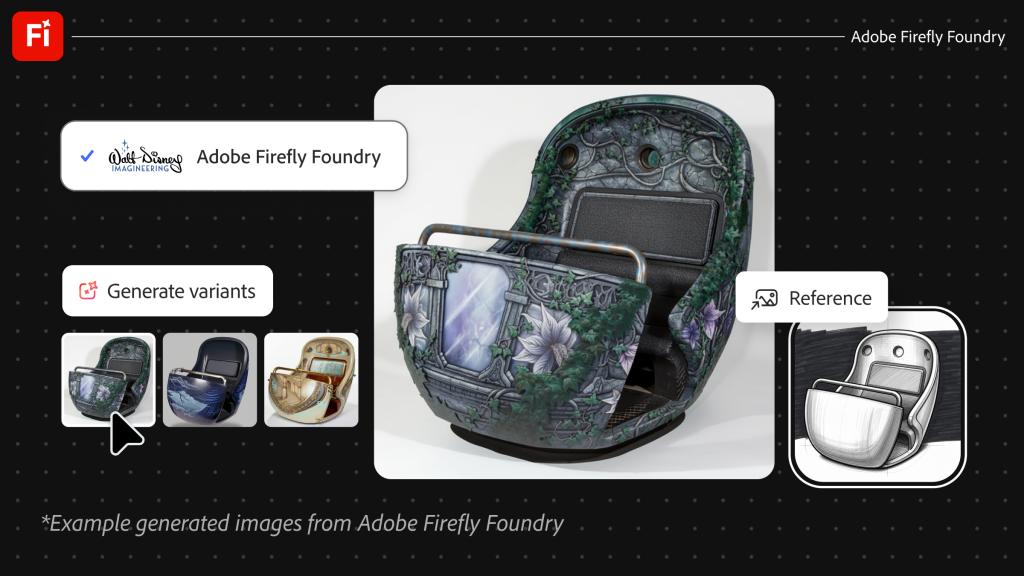
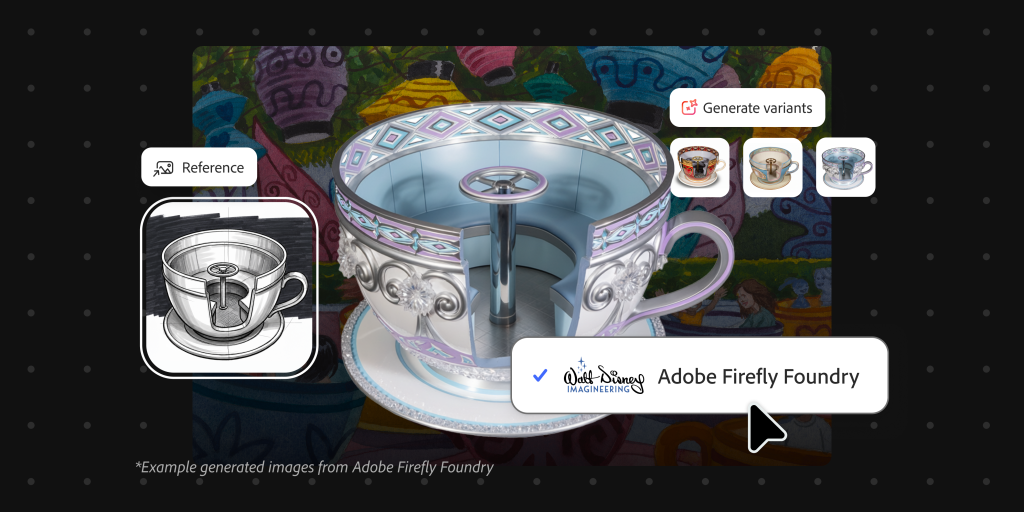
Walt Disney Imagineering designs Disney’s parks, rides and attractions, and in June it explained how it was using Adobe’s tools. The headline example is a sketch-to-image model. An Imagineer draws a ride vehicle or a piece of scenery by hand, and the model turns that drawing into fully rendered 2D concept art, with variants to choose from. The examples Disney released, a ride car covered in ivy and a teacup ride in the style of the Mad Tea Party, are shown on this page.
Kyle Laughlin, senior vice president of Walt Disney Imagineering Research and Development, was blunt about the appeal. “What’s most exciting is that it allows months of work to be compressed into days and weeks,” he said. He also leaned on a line Imagineers use a lot: “our product is emotion”. The tools, he said, are “helping us make that connection even faster”.
That “months into days” line is the one to remember. It’s the honest version of what studios want from AI. Not a computer that dreams up a film by itself, but a pipeline where the slow, expensive in-between steps happen much faster. In theme parks, that means concept art and pitch boards. In film and TV, the obvious equivalents are concept art, storyboards, pre-visualisation and marketing assets.
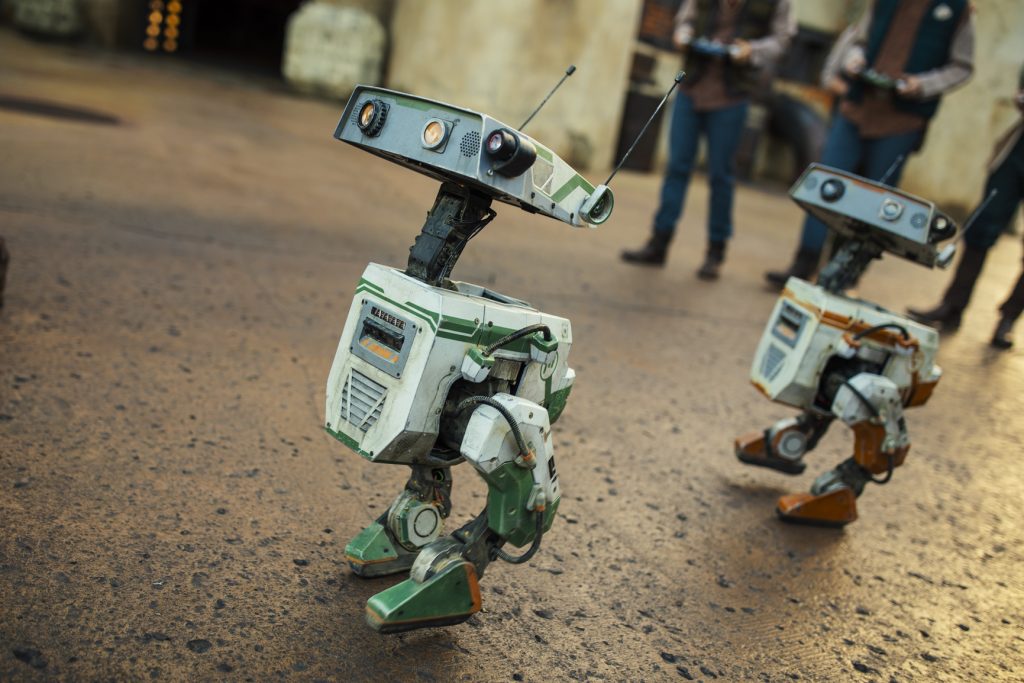
Imagineering’s other technology work points the same way. Disney says it built its walking BDX droids over about a year using NVIDIA’s Newton simulation framework, and then built a robotic Olaf in about four months on the back of that work. Speed is the theme running through everything.
5. StudioLAB and the Film Studio Angle (Walt Disney Studios)
What makes it stand out: Adobe is joining StudioLAB, the Walt Disney Studios innovation hub, which is where any AI use in Disney’s films is most likely to be tried first.
Key data: Adobe becomes a StudioLAB Innovation Partner; the two will explore “internal creative workflows”; co-innovation projects are already underway, per the 9 November announcement.
Why it matters: This is the part of the deal that connects to Marvel, Pixar, Lucasfilm and Walt Disney Animation, the studios people actually care about.
StudioLAB is Disney Studios’ internal technology unit, set up to prototype ideas and turn successful experiments into tools that productions can use. If you want to know whether a Star Wars film or a Pixar feature will use a Firefly Foundry model, StudioLAB is the door that would happen through.
The language here is deliberately modest. “Internal creative workflows” could mean almost anything, from generating mood boards for a pitch to helping an editor find shots in Premiere. Nobody has said Firefly-made images will appear in a finished Disney film, and it would be a big, public decision if they did.
That caution makes sense. Disney has watched what happens when AI shows up on screen without warning. Marvel’s Secret Invasion opening titles in 2023 drew criticism when the studio confirmed they’d been made with AI, and earlier this year Amazon MGM’s AI-assisted animation project Punky Duck lost its creator, Jorge R. Gutierrez, after a backlash from artists and fans. Disney will know that any first use in a major film will be scrutinised frame by frame.
6. ESPN Edge and the Sports Archive (ESPN)
What makes it stand out: ESPN brings decades of sports footage into the deal, which is a very different use case from animation.
Key data: Adobe will work with the ESPN Edge Innovation Center on fan engagement, content delivery and archive projects; work is already underway.
Why it matters: Archive footage is where AI restoration, search and remixing tools could reach screens soonest, and with the least argument.
ESPN Edge is ESPN’s innovation centre for new technology in sports storytelling. The companies have said they’ll look at using AI to engage sports fans and to “bring ESPN’s archive to life”, which is a phrase that could cover restoration, smarter searching, automatic highlight packages or personalised clips.
It’s a less glamorous part of the deal, and it’ll get far less attention than Mickey Mouse. But it might be the first to produce something viewers notice. Sports broadcasters have been using AI for highlights and graphics for a while, and the arguments about authorship and jobs are much quieter there than they are in animation.
7. What Adobe Gets in Return (Parks, Cruise Line, Events)
What makes it stand out: A large part of this deal is marketing, and Adobe gets a presence at some of the most visited places in the world.
Key data: Adobe gains marketing activations, events, thought leadership and customer storytelling with Walt Disney World, Disneyland, Disney Cruise Line, ESPN Edge and StudioLAB, plus a bigger presence on Disney’s media platforms; the alliance will feature at Adobe Summit and Adobe MAX.
Why it matters: It shows Adobe sees Disney’s name as worth a lot to its AI business, and that the deal is as much about trust and branding as about software.
Read the press release closely and roughly half of it is about what Adobe can say and where it can say it. That’s normal for a big corporate alliance. Disney has long had official corporate sponsors. Now it has one for AI.
For Adobe, that’s a valuable endorsement at a tricky time. The creative software market is crowded with AI rivals, and Adobe has faced criticism from some of its own users who see generative AI as a threat to their jobs. Being able to say “Disney trusts us” is a strong answer to both problems. RedShark News called the deal “a definite feather in Adobe’s cap”, and that seems fair.
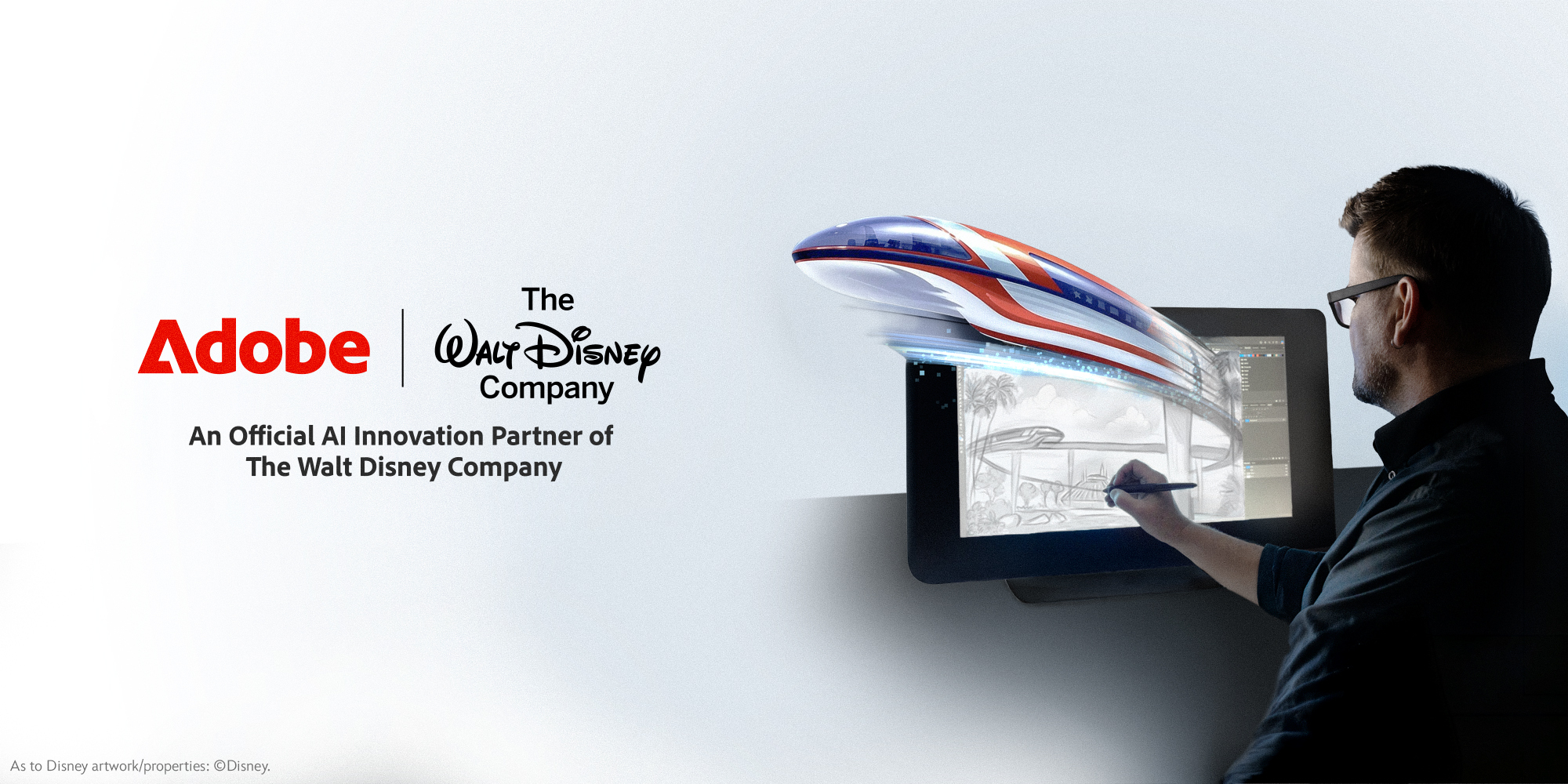
For Disney, the marketing side is a way of making the deal pay for itself, at least in reputation. And it lets Disney put a human face on its AI use, showing artists using tools rather than machines replacing artists. You can see that framing in the official image at the top of this page: a person, a pen and a sketch of a monorail.
Disney Cruise Line and the US parks are the venues named. Disneyland Paris isn’t, which means UK visitors to Disney’s European resort shouldn’t expect Adobe-branded experiences there based on what’s been announced.

8. What Hasn’t Been Disclosed (As of 15 November 2026)
What makes it stand out: For a deal this big, the list of unknowns is long.
Key data: No fee, investment or revenue figure; no contract length beyond “multi-year”; no named film, series or Disney+ title; no rollout timetable.
Why it matters: Until a real production uses these models, it’s hard to judge whether this changes how Disney makes films or mainly how it talks about AI.
Here’s what we don’t know. We don’t know whether money is changing hands, or in which direction. We don’t know how long “multi-year” means. We don’t know which Disney studio gets the custom models first, or whether any will be used on something released in 2027.
We also don’t know how far the models will go. Will they stay in concept art and pitch decks, as at Imagineering? Will they generate background plates, crowd shots or marketing images? Could they ever produce footage that ends up in a finished Disney+ series? None of the official material answers those questions, and one analysis of the deal pointed out that the announcements don’t say which Adobe tools will reach Disney’s productions first.
9. The OpenAI Deal That Died (December 2025 to March 2026, OpenAI and Disney)
What makes it stand out: Disney’s last big AI bet collapsed within about four months.
Key data: Disney agreed in December 2025 to license characters to OpenAI’s Sora video app and invest $1 billion in OpenAI; OpenAI announced on 24 March 2026 that it was shutting down Sora, and the Disney deal ended with it.
Why it matters: The Adobe deal looks a lot like Disney learning from that experience: less public-facing, more controlled, and built on its own data.
The OpenAI deal was a very different idea. It would have let ordinary Sora users make short videos featuring Disney, Marvel, Pixar and Star Wars characters, with some of that fan content potentially appearing on Disney+. It was splashy, consumer-facing and widely criticised by artists at the time.
Then, in March, OpenAI said it was discontinuing the standalone Sora app. Bloomberg was among the outlets reporting that the Disney arrangement was being wound down, and Disney confirmed it wasn’t going ahead, while saying it would continue to engage with AI platforms. Reports since have differed on whether any of the $1 billion was ever paid.
The contrast with the Adobe deal is striking. The OpenAI deal put Disney characters in the hands of the public. The Adobe deal keeps them inside Disney, in models only Disney’s teams can use. RedShark’s Andy Stout suggested Disney “will have searched very carefully before putting its eggs into the AI basket once more”, and the structure of the new deal backs that up.
10. Suing Midjourney While Building Its Own Models (June 2025 Onwards, US Federal Court)
What makes it stand out: Disney is in court accusing one AI company of copyright infringement while signing up another to build AI on its characters.
Key data: Disney and Universal sued Midjourney in June 2025 in the Central District of California, with Warner Bros. Discovery later bringing its own claims; in June 2026 a magistrate judge limited discovery to studios’ consumer-facing AI uses, and Midjourney has challenged that ruling.
Why it matters: The Adobe deal helps Disney argue that it isn’t against AI, only against AI built on its work without permission.
The Midjourney case accuses the AI image company of letting users generate pictures of characters like Darth Vader, Elsa and the Minions, which the studios say amounts to copying on a massive scale. It’s the biggest copyright fight Hollywood has picked with an AI firm so far.
Midjourney’s defence has included trying to show that the studios use AI themselves. In June 2026, Magistrate Judge Joel Richlin limited discovery to AI materials linked to consumer-facing uses, which meant the studios’ internal AI work generally didn’t have to be handed over. Midjourney asked a district judge to overturn that in July, and we haven’t seen a report of a decision.
You can see why the Adobe deal fits Disney’s legal strategy so neatly. Disney’s position is that AI trained on its characters is fine when Disney owns and controls it, and infringement when someone else does it without a licence. A Firefly Foundry model trained on Disney’s own archive is the clearest possible example of the first.
There’s an awkward wrinkle in item 11, though. In December 2025, Disney also sent Google a cease-and-desist letter accusing it of large-scale copyright infringement through its AI models. A day after the Disney deal, Adobe announced it was bringing more Google AI models into its apps.
11. Adobe’s Google Tie-Up, a Day Later (10 November 2026, Adobe and Google)
What makes it stand out: Adobe’s second big MAX announcement deepened its ties with Google, whose video and image models already sit inside Adobe’s apps.
Key data: Google’s Gemini Omni, Veo and Nano Banana models continue to reach Firefly, Photoshop, Express and Premiere; Adobe and Google DeepMind will explore a custom Google image model for Photoshop; Adobe tools are coming to Google Search’s AI Mode.
Why it matters: Adobe is now both the “safe” home of Disney’s private models and a shop window for third-party models with very different training histories.
Adobe has been pitching its apps as a place where creators can pick from many AI models, its own and partners’, all in one workflow. The Google announcement on 10 November pushed that further. Gemini models will help power features in Acrobat, Acrobat is coming to Google Workspace, and Google DeepMind and Adobe are exploring a near-real-time image model for Photoshop.
That’s good for most Adobe users. It does create a question for a customer like Disney, though. The custom Firefly Foundry models are trained on Disney’s own material. The partner models offered elsewhere in Adobe’s apps aren’t. Disney’s teams will need clear rules about which models they can use, and on what.
There’s no suggestion that Disney’s custom models use Google technology. The announcements are separate, and the Disney deal centres on Firefly Foundry. But the timing shows that Adobe’s AI business is bigger and messier than the clean “commercially safe” story in item 3.
12. Artists, Jobs and the Guilds (2026, Pixar, SAG-AFTRA and Concept Artists)
What makes it stand out: The deal lands months after Disney cut jobs at Pixar, and at a time when artists are deeply sceptical of studio AI promises.
Key data: Pixar laid off at least 116 staff in late July 2026, according to TheWrap, with Cartoon Brew later putting the figure at about 150; SAG-AFTRA’s 2026 TV and theatrical contract, which includes AI performer provisions, runs from 1 July 2026 to 30 June 2030.
Why it matters: “Artist-led” will only mean something if artists are still employed to lead.
Creative Bloq’s coverage of the deal ran under the headline “Disney’s AI deal with Adobe is raising eyebrows”, and it said the expansion would be concerning for concept artists in particular. That’s the group most directly in line. If a sketch-to-image model can turn a rough drawing into polished concept art, fewer people may be needed to do the polishing.
The Pixar layoffs make the mood worse, even though nobody has linked them to AI. They came while Toy Story 5 was heading towards a billion dollars at the box office, with reports pointing to production and operations roles and to Pixar’s shift to a “long and lean” schedule. Artists hearing “AI partner” a few months later are always going to connect the two, fairly or not.
The unions have some protections in place. SAG-AFTRA’s new four-year contract, ratified by members earlier this year, sets rules on digital replicas and synthetic performers. The WGA’s 2026 agreement extended its 2023 AI protections for writers. But Firefly Foundry’s first uses are in concept art and design, where many US artists work under the Animation Guild or without union cover at all, and where UK artists rely on unions such as Equity and BECTU that are still pushing for stronger AI terms.
Adobe and Disney both say AI should help artists, not replace them. Disney’s Kyle Laughlin put it as “use technology to support storytelling”. That’s the right thing to say. The proof will be in Disney’s hiring numbers over the next couple of years, not in its press releases.
We’ve followed this tension closely, from Hollywood’s AI deal-making boom to the fight over Tilly Norwood and Gods Don’t Give Gifts, the AI film chasing an Oscar. The Disney and Adobe deal is the corporate end of the same story.
Where This Leaves Disney and Its Audiences
Strip out the sponsor language and the deal is fairly simple. Disney has chosen Adobe to build private AI models trained on its own characters and worlds, after its public-facing OpenAI experiment fell apart. Imagineering is already using them to turn months of concept work into weeks. The film studios, through StudioLAB, are next in line.
For people watching Disney films and series in the UK, nothing changes yet. No title has been named, and the first uses will almost certainly be behind the scenes. The thing to watch is the first Disney production that openly credits these tools, and how its artists, its guilds and its audience react. Our guess is that it’ll be a theme park or marketing project before it’s a film. When it does reach a film, expect it to be argued over shot by shot.
Sources: Adobe newsroom (official announcement), TheWrap, GamesBeat, RedShark News (Google tie-up), The Walt Disney Company (Imagineering and Adobe), Bloomberg (Sora shutdown and Disney deal).
Frequently Asked Questions
When did Disney name Adobe its AI partner?
Disney named Adobe its Official AI Innovation Partner on 9 November 2026, in an announcement made at Adobe MAX in Miami Beach, Florida.
What is Adobe Firefly Foundry?
Adobe Firefly Foundry is an enterprise service that builds private generative AI models trained on a company’s own licensed or owned content, so the models can produce images, video, audio, 3D and vector work in that brand’s style.
Will Disney use AI to make its films?
Disney has not said any film will use the new models. The deal covers Disney Studios’ StudioLAB innovation hub and internal creative workflows, but no film, series or Disney+ title has been named.
How much is the Disney and Adobe deal worth?
The value of the Disney and Adobe deal has not been disclosed. Neither company has given a fee, investment figure or contract length beyond calling it multi-year.
What happened to Disney’s deal with OpenAI?
Disney’s deal with OpenAI ended after OpenAI announced on 24 March 2026 that it was shutting down its Sora video app. The December 2025 agreement had included a planned 1 billion dollar Disney investment in OpenAI and character licensing for Sora.
Is Disney still suing Midjourney?
Yes, Disney and Universal’s copyright lawsuit against Midjourney, filed in June 2025 in the Central District of California, was still ongoing as of November 2026, with no ruling on the main claims reported.
How is Walt Disney Imagineering using Adobe AI?
Walt Disney Imagineering uses Firefly Foundry for theme park design, including a sketch-to-image model that turns hand-drawn concepts into rendered 2D concept art and a custom model for franchise-accurate assets.
Who announced the Disney and Adobe partnership?
The partnership was announced by Hannah Elsakr, Adobe’s vice president of GenAI new business ventures, and Becca Vodnoy, senior vice president of corporate alliances at The Walt Disney Company.
Does the Adobe deal affect Disney+ in the UK?
Not yet. No Disney+ UK title or UK cinema release has been linked to the Adobe models, and no UK-specific terms have been announced.
Is Adobe Firefly trained on copyrighted images?
Adobe says Firefly is trained on licensed content, such as Adobe Stock, and public domain material, and Disney says its custom models use its own licensed and proprietary assets. These are company claims that have not been tested in court.
📸 Follow us on Instagram for daily film, TV & gaming news: @filmoriauk

Jon Dingle Editor
A film journalist, writer and a filmmaker in business for over 20 years. I am passionate about movies, television series, music and online games. When I'm not reviewing the latest releases, you'll usually find me deep in a retro gaming session or catching up on the newest prestige drama. I believe great storytelling deserves an honest take, whatever the screen it's on.